
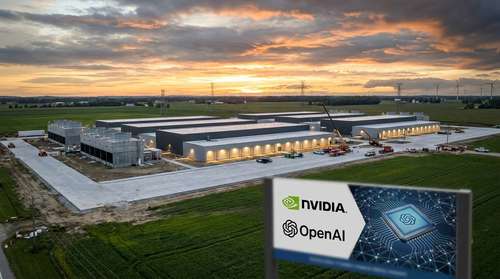
The artificial intelligence sector is bracing for its most ambitious infrastructure play yet. Nvidia and OpenAI are reportedly in advanced negotiations for an unprecedented Nvidia OpenAI $250 billion financial guarantee that would enable the ChatGPT creator to lease a massive Ohio 10 gigawatt data center campus. The sweeping agreement, which surfaced over the weekend, represents a watershed moment in AI infrastructure financing, as semiconductor giants step beyond manufacturing to directly bankroll their biggest clients' physical expansion efforts.
Unpacking the $500 Billion Mega-Project
The proposed facility, located on a decommissioned federal uranium enrichment site in Piketon, southern Ohio, is staggering in its scale. Developed by SoftBank SB Energy Ohio, the energy subsidiary of the Japanese tech conglomerate, the total project costs are projected to easily exceed $500 billion once advanced computing hardware is factored in.
At full capacity, the site would draw 10 gigawatts of electricity—an astronomical figure that equals the power consumption of approximately 8.4 million average American homes. The initial phase of the OpenAI Ohio campus is targeting 800 megawatts of power, with an expected completion date in 2028. If finalized, this development would easily dwarf all existing data center projects worldwide, serving as a mega-symbol of the immense computing demand driving modern AI development.
The Mechanics of the Financial Backstop
Why does a high-flying pioneer like OpenAI need a hardware supplier to co-sign its lease? The answer lies in the stringent demands of credit markets. As a privately held enterprise that has yet to turn a consistent profit, OpenAI currently lacks the investment-grade credit rating required to secure favorable, low-interest borrowing terms for a project of this magnitude.
Nvidia's pristine corporate balance sheet would effectively stand in for the borrower's. By providing the guarantee, Nvidia allows SoftBank's developers to raise debt against the chipmaker's credit profile rather than the AI lab's unproven financials. The $250 billion commitment specifically covers the real estate lease and the debt required for physical construction.
Crucially, this figure is entirely separate from Nvidia chip financing. The two tech titans are simultaneously discussing an additional arrangement worth up to $350 billion specifically to fund OpenAI's purchase of the underlying AI accelerators and servers that will fill the Ohio halls.
The Circular Financing Controversy
This unprecedented debt structure has already sparked intense debate on Wall Street over the systemic risks of circular financing. Nvidia is essentially underwriting the capital that OpenAI will ultimately use to purchase more Nvidia hardware. While this aggressive move effectively locks in massive long-term hardware demand for the chipmaker, it deeply intertwines the financial health of the two entities.
Credit markets have reacted swiftly to the news. Over the last 48 hours, Nvidia's credit default swap premiums spiked to record levels amid growing institutional concerns over the company's rapidly expanding contingent liabilities. If investor sentiment regarding AI growth cools, or if OpenAI fails to monetize its models effectively, Nvidia could find itself heavily exposed to its partner's massive commercial real estate obligations.
Howard Lutnick and the Geopolitics of Power Allocation
Securing the land and the capital is only part of the equation; securing the raw electricity is equally complex. The power supply for the federal land in Piketon is intrinsically tied to international trade geopolitics. Japan recently agreed to invest $33 billion into a natural gas power plant on the site in exchange for lower U.S. tariffs, a diplomatic deal that will directly fund the necessary energy infrastructure. Proceeds from electricity sales at the data center will be shared between the U.S. and Japan until Tokyo fully recoups its $33 billion investment, after which the U.S. government will retain 90 percent control of the revenues.
This unique public-private structure places immense authority in the hands of the federal government. Howard Lutnick power allocation decisions will dictate which tech giants ultimately gain access to the highly coveted grid. While OpenAI is the presumed frontrunner and has been engaged in advanced leasing talks for weeks, the competition remains fierce. Commerce Secretary Lutnick has recently fielded direct inquiries from Anthropic, Google, and Microsoft, all of whom are eager to secure a foothold in the unprecedented 10-gigawatt energy pool to fuel their own rival models.
What the OpenAI Ohio Campus Means for the Industry
A finalized deal would mark a major strategic pivot for OpenAI. Currently, the company relies almost exclusively on cloud capacity rented from Microsoft, Amazon, and Oracle to train and run its flagship ChatGPT software. Operating the Ohio campus as a direct tenant on a 20-year lease would give OpenAI unprecedented autonomy over its computing stack, bringing it closer to total infrastructure independence.
The stakes reflect soaring internal forecasts. OpenAI recently adjusted its projected computing expenditure to a staggering $750 billion through the year 2030, a sharp increase from previous estimates of $600 billion made earlier this year. As artificial intelligence models grow exponentially more resource-intensive, the race for market supremacy is no longer just about optimizing software algorithms. It is now a heavy industrial battle fought with steel, electricity, and highly creative Wall Street financing.