President Donald Trump has ignited a constitutional firestorm less than nine months before the 2026 midterms, explicitly calling for a "federal takeover" of local elections in key battleground jurisdictions. His comments, delivered during a blistering podcast appearance this week, coincide with the Republican introduction of the Make Elections Great Again (MEGA) Act—a sweeping legislative package designed to nationalize election standards and outlaw alternative voting methods across the United States.
The MEGA Act: A Radical Shift in Voting Laws
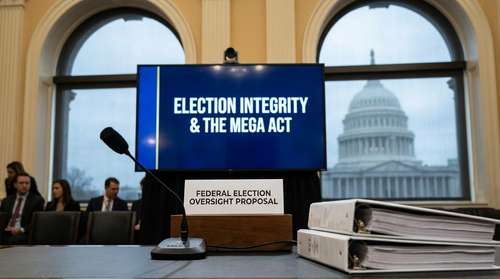
On January 30, 2026, Representative Bryan Steil (R-Wisc.) introduced the MEGA Act Voting Bill, a 120-page omnibus aimed at fundamentally reshaping how Americans cast their ballots. While proponents argue the bill establishes necessary "baseline standards" for 2026 Midterm Election Integrity, critics view it as an unprecedented usurpation of states' rights.
The legislation incorporates the most aggressive provisions of the previously stalled SAVE Act, mandating documentary proof of citizenship for all voter registrations. However, it goes much further. The MEGA Act would federally ban universal vote-by-mail systems, require "auditable" paper ballots nationwide, and impose strict new voter ID requirements that would override state laws in Democratic strongholds.
"Americans deserve confidence that their elections are secure and reflect the will of the people," said Ohio Secretary of State Frank LaRose in a statement supporting the bill. "The MEGA Act builds on practices that make elections the gold standard."
Trump Calls for "Nationalization" Following Georgia Raid
The legislative push comes days after an unprecedented Trump Georgia Election Raid sent shockwaves through the political establishment. On January 28, FBI agents seized over 650 boxes of ballots and records from the Fulton County election headquarters in Atlanta, ostensibly to investigate lingering claims regarding the 2020 election.
Emboldened by the raid, President Trump appeared on Dan Bongino’s podcast to demand even more drastic action. "The Republicans should say, 'We want to take over,'" Trump declared. "The Republicans ought to nationalize the voting. We should take over the voting in at least 15 places."
This rhetoric represents a sharp escalation in the administration's strategy. By advocating for Federal Election Nationalization, Trump is challenging the long-standing constitutional principle that states maintain authority over the "times, places, and manner" of elections. Legal scholars warn this could trigger a Constitutional Crisis 2026 if the Department of Justice attempts to unilaterally seize control of local election boards under the guise of civil rights enforcement.
The Federal Ban on Ranked Choice Voting
One of the most controversial aspects of the MEGA Act is its targeted elimination of electoral innovations. The bill includes a specific Ranked Choice Voting Ban for all federal elections, a direct challenge to states like Maine and Alaska that have successfully implemented the system.
Ranked-choice voting (RCV), which allows voters to rank candidates by preference, has been praised by reformers for reducing polarization. However, the MEGA Act would strip states of federal funding if they employ RCV, effectively forcing them to return to winner-take-all plurality systems. This provision has drawn sharp condemnation from voting rights advocates who argue that Congress lacks the authority to dictate state-specific voting methods.
Constitutionality and State Resistance
The Voting Rights Act Challenges expected to emerge from this legislation are immense. "The MEGA Act is not about integrity; it is about control," stated Rep. Saira Draper (D-Ga.), who witnessed the Fulton County raid. "Banning ranked-choice voting and demanding federal oversight of local boards is a direct attack on the laboratory of democracy."
Looming Midterm Chaos
As the MEGA Act moves to the House Administration Committee for hearings, the political temperature is reaching a boiling point. With the 2026 Midterm Election Integrity narrative now centered on federal intervention versus state sovereignty, election administrators are bracing for a chaotic year.
If passed, the MEGA Act would not only overhaul logistical procedures but would also signal a permanent shift in the balance of power between Washington and the states. Whether the courts will allow such a dramatic centralization of election authority remains the defining question of the 2026 election cycle.