WASHINGTON — A new era of trade volatility begins today as President Donald Trump's 10% global tariff officially takes effect, utilizing a little-known provision of the Section 122 Trade Act 1974 to circumvent a landmark Supreme Court defeat. The executive order, which leverages the president's authority to address balance-of-payments deficits, comes just four days after the high court struck down his previous "reciprocal" levies in a stinging 6-3 decision, prompting the president to label the justices "disloyal" and setting the stage for a constitutional showdown ahead of the 2026 midterms.
The Pivot to Section 122: A New Legal Battleground
Effective 12:01 a.m. Tuesday, Customs and Border Protection (CBP) began collecting a 10% surcharge on nearly all foreign imports. This move represents a swift and aggressive pivot by the White House following the Supreme Court's February 20 ruling in Learning Resources, Inc. v. Trump, which declared that the International Emergency Economic Powers Act (IEEPA) did not grant the president the power to impose tariffs. Undeterred, President Trump immediately invoked Section 122 of the Trade Act of 1974, a statute that allows for temporary import surcharges of up to 15% for a maximum of 150 days to counter "large and serious" balance-of-payments deficits.
"They thought they could stop us on a technicality, but the law is clear about protecting our dollar," President Trump told reporters yesterday, signaling his willingness to escalate the rate to the statutory maximum of 15% if trade partners retaliate. Legal experts warn that while Section 122 offers a temporary shield, it places the administration on a collision course with Congress. Unlike IEEPA, Section 122 requires congressional approval to extend tariffs beyond the 150-day window, effectively setting a legislative time bomb that will detonate in July, right as the US trade policy 2026 midterms campaign season heats up.
Supreme Court Tariff Ruling 2026: The IEEPA Strike Down
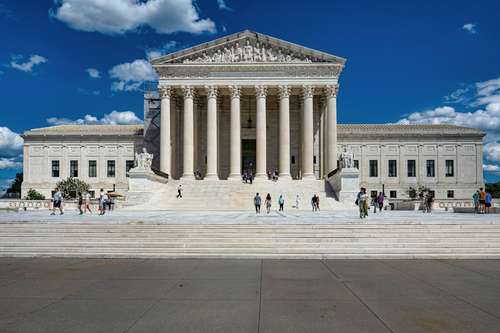
The catalyst for today's chaos was last week's historic Supreme Court tariff ruling 2026. In an opinion authored by Chief Justice John Roberts, the Court held that the power to "regulate importation" under IEEPA does not include the power to tax, striking down the administration's sweeping "reciprocal" tariff framework. The decision was a resounding rejection of executive overreach, with the majority emphasizing that the "power of the purse" belongs exclusively to Congress.
The reaction from the Oval Office was blistering. In a series of statements, President Trump Supreme Court disloyal rhetoric reached new heights, accusing the conservative majority—including three of his own appointees—of betraying the movement that put them on the bench. "These justices are a disgrace to the nation," Trump posted, vowing that the new Section 122 tariffs would be "more powerful and more crystal clear" than the ones they replaced.
The "Disloyal" Court and Constitutional Crisis
The intensity of the President's attacks on the judiciary has alarmed legal scholars and lawmakers alike. By pivoting so rapidly to a different statute to achieve the same economic outcome, the administration is effectively challenging the Court's role as the final arbiter of constitutional power. "This is a game of legislative whack-a-mole," said Newsvot political analyst Sarah Jenkins. "The Court said 'no' to IEEPA, so the President found a dusty 1974 law to say 'yes.' It forces the Court to rule again, but by the time they do, the 150-day clock might already be up."
Economic Fallout and Importer Confusion
For American businesses, the Trump Section 122 executive order has created an environment of unparalleled uncertainty. Importers who paid billions under the now-illegal IEEPA regime are scrambling to understand if and how they will be refunded, a process the Supreme Court left undefined. Meanwhile, supply chains are bracing for the new Section 122 levies. The 10% flat rate applies globally, removing the country-specific nuances of the previous system and hitting allies and adversaries alike.
Trade groups have already signaled intent to challenge the new order, arguing that the U.S. does not currently face the type of "balance-of-payments emergency" the 1974 Act was designed to solve. However, litigation takes time—time that the administration is using to reshape global trade flows. "We are seeing a weaponization of obscure trade statutes," noted a senior economist at the Peterson Institute. "Section 122 was meant for currency crises in the 1970s, not as a tool for permanent protectionism in 2026."
Congressional Showdown Looms
The focus now shifts to Capitol Hill. With Trump reciprocal tariffs unconstitutional under the previous framework, the burden is on Congress to either ratify or reject the Section 122 extension before the July deadline. Democratic leadership has already drafted resolutions of disapproval, but the Republican-controlled Senate remains divided. Some GOP senators, wary of the economic drag of high tariffs, have expressed quiet relief at the Court's ruling, only to be cornered by the President's immediate counter-move.
As the 150-day clock ticks down, the Newsvot political analysis suggests that trade policy will become the defining issue of the midterm cycle. Candidates will be forced to choose between backing the President's executive assertiveness or siding with the Court's defense of congressional authority—a choice that could determine control of Congress for the remainder of the term.