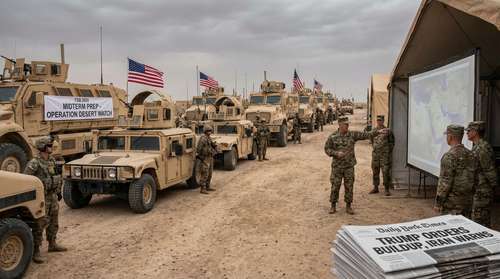
President Donald Trump has ordered a massive deployment of U.S. naval and air forces to the Middle East, signaling the potential for a "weeks-long" air campaign against Iran. The escalation comes just days after the President issued a stark ultimatum to Tehran regarding its nuclear program, and amid a record-low approval rating of 39 percent that has intensified the political stakes ahead of the 2026 midterms. With the USS Gerald R. Ford carrier strike group now entering the Mediterranean and the USS Abraham Lincoln already on station in the Arabian Sea, the region stands on the precipice of a conflict that experts warn could dwarf the limited strikes of 2025.
Massive Military Buildup Signals Imminent Action
The Pentagon has accelerated what officials are calling the largest projection of American combat power in the region since the 2003 invasion of Iraq. The deployment includes the USS Gerald R. Ford—the world's largest aircraft carrier—which was photographed Friday transiting the Strait of Gibraltar. It joins the USS Abraham Lincoln carrier strike group, effectively sandwiching the Islamic Republic between two massive armadas.
According to defense sources, the White House has directed the Pentagon to prepare for "sustained, weeks-long operations" aimed at dismantling Iran's reconstituted nuclear infrastructure and ballistic missile arsenal. This follows the "Operation Midnight Hammer" strikes of June 2025, which set back Tehran's program but failed to secure a lasting diplomatic solution. "The assets are in place," a senior defense official told NewsVot on condition of anonymity. "We are waiting on the President's final order, but the capability to strike is absolute."
Trump's Ultimatum and Nuclear Deadlock
The military mobilization serves as the "big stick" in President Trump's high-stakes diplomatic gamble. Speaking at the inaugural meeting of the Board of Peace in Washington last Thursday, Trump gave Iranian leaders a strict window to capitulate to U.S. demands. "I would think that would be enough time, 10, 15 days, pretty much maximum," Trump stated, warning that if a verifiable halt to enrichment is not reached, "bad things happen."
Vice President JD Vance reinforced the administration's hawkish stance, telling reporters that Tehran has been "unwilling to acknowledge" the President's red lines during recent talks in Geneva. The core dispute remains Iran's rapid rebuilding of its centrifugal capacity following the 2025 strikes and its refusal to allow new IAEA inspections. Intelligence reports suggest Iran has replenished its medium-range missile stockpile to near pre-war levels, posing a renewed threat to U.S. bases in Qatar and Bahrain.
Iran's Internal Crisis and "Crisis of Legitimacy"
The external threat of war comes as the Iranian regime faces its most severe internal crisis since 1979. The country has been rocked by months of mass protests sparked by economic collapse and currency devaluation. The unrest, which began in late 2025, culminated in a brutal crackdown in January 2026 that left thousands of demonstrators dead. Amnesty International and other human rights groups have described the events as "crimes against humanity," further isolating Tehran on the global stage.
Despite President Masoud Pezeshkian's rare public apology for the violence earlier this month, Supreme Leader Ali Khamenei has remained defiant, labeling protesters as "rioters" and foreign agents. Analysts believe the regime may view a conflict with the United States as a necessary distraction to rally domestic support, or conversely, that the internal "crisis of legitimacy" makes the government too fragile to survive a sustained American air war. "The regime is cornered," notes regional expert Dr. Sarah Jenkins. "And cornered regimes are unpredictable."
2026 Midterms and Domestic Political Fallout
The looming conflict is reshaping the domestic political landscape as the U.S. barrels toward the 2026 midterm elections. President Trump's approval rating has dipped to 39 percent, a new low for his second term, driven by voter fatigue with foreign entanglements and economic jitters at home. The Republican Party, currently holding a razor-thin majority in the House (218-214) and a 53-seat majority in the Senate, faces a challenging map.
Democrats have seized on the escalation, characterizing it as a "reckless march to war" intended to distract from domestic polling woes. In contrast, GOP leadership argues that re-establishing deterrence is vital for national security, echoing themes from the President's State of the Union 2026 address where he vowed to "end the cycle of Iranian aggression." With control of Congress in the balance, the outcome of this standoff—whether it ends in a diplomatic breakthrough or a kinetic war—will likely decide the fate of the Trump agenda for the remainder of his term.
What Comes Next?
As the 10-day deadline ticks down, diplomatic channels remain open but strained. White House envoys Steve Witkoff and Jared Kushner have reportedly engaged in back-channel talks, but optimism is scarce. For now, the world watches the waters of the Persian Gulf and the Mediterranean, waiting to see if the "maximum pressure" campaign will yield a deal or ignite a regional conflagration.