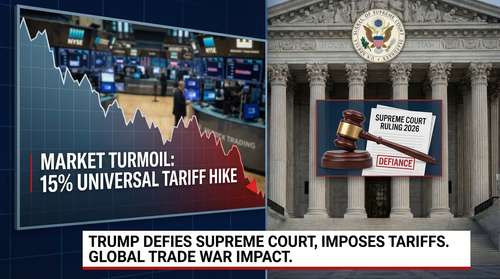
Global markets were thrown into fresh chaos this morning as President Trump announced an immediate 15% universal tariff hike on all foreign imports, effectively sidestepping a landmark Supreme Court ruling that had struck down his administration's previous trade policies just 48 hours earlier. The aggressive move, invoked under a rarely used provision of the Trade Act of 1974, has reignited fears of a prolonged global trade war and sent U.S. businesses scrambling to decipher a conflicting legal landscape. As Wall Street digests the news, the Dow Jones Industrial Average plummeted in pre-market trading, signaling deep investor anxiety over the administration's refusal to pivot from protectionist economics.
President Invokes Section 122 to Bypass High Court
In a stunning display of executive defiance, the White House has leveraged Section 122 of the Trade Act of 1974 to implement the new duties. This obscure statute grants the President authority to impose temporary import surcharges of up to 15% for 150 days to address fundamental balance-of-payments deficits. The maneuver comes directly on the heels of Friday’s 6-3 Supreme Court decision, which declared the administration's previous "Liberation Day" tariffs—imposed under the International Emergency Economic Powers Act (IEEPA)—unconstitutional.
Legal experts describe the pivot as a "constitutional hardball" strategy. While the Supreme Court successfully curbed the use of emergency powers for economic policy, Section 122 offers a narrower, yet potent, legislative escape hatch. "The President is technically operating within the letter of the law, even if he is violating the spirit of the Court's ruling," notes trade attorney Sarah Jenkins. "By shifting the legal basis from 'national emergency' to 'balance of payments,' the administration has bought itself five months of tariff enforcement while daring Congress to intervene."
Corporate Tariff Refunds: The Billion-Dollar Battle
The Supreme Court's ruling on Friday did offer one glimmer of hope for American importers: the potential for massive corporate tariff refunds. With the IEEPA-based duties declared illegal, U.S. businesses are theoretically owed an estimated $175 billion in unlawfully collected taxes. However, the path to repayment is fraught with bureaucratic obstacles. The Court's decision did not outline a specific refund mechanism, leaving thousands of companies in a legal limbo.
Major retail associations and manufacturing coalitions are already preparing a flood of lawsuits to force the Treasury Department's hand. "We are looking at the largest tax refund litigation in U.S. history," says manufacturing lobbyist Mark Danton. "Small businesses that operated on razor-thin margins to pay these illegal duties are demanding immediate restitution. The administration's silence on the refund process, coupled with the new 15% levy, feels like a double punishment for complying with the law."
Uncertainty for Importers
Customs and Border Protection (CBP) has yet to issue guidance on how it will process refund claims for the struck-down tariffs. This administrative paralysis means that while companies may legally be entitled to billions back, seeing that cash could take years of litigation in the Court of International Trade.
Global Trade Partners Threaten Retaliation
International reaction to the Trump 15% tariff hike has been swift and furious. The European Union, which had tentatively paused retaliatory measures pending the Supreme Court's verdict, expressed "profound disappointment" at the new escalation. EU Trade Commissioner Valdis Dombrovskis warned that the bloc is preparing a "proportionate and immediate" counter-response, targeting U.S. agricultural exports and digital services.
The United Kingdom, previously negotiating a separate exemption, now finds itself caught in the crossfire. The new blanket nature of the Section 122 tariffs means that even close allies are not spared. Diplomatic cables suggest that key partners in the G7 are viewing this latest move not just as trade policy, but as a destabilizing force in the global economic order. "A deal is a deal," one EU diplomat remarked, referencing prior agreements that are now seemingly void. "We cannot negotiate with a partner who changes the rules of the game every time they lose a hand."
Markets React to Trade Policy Volatility
The market reaction to trade policy shifts has been volatile. Gold prices surged to new highs as investors sought safe-haven assets, while the U.S. dollar weakened against major currencies, reflecting doubts about the long-term stability of American trade relations. Sectors heavily reliant on global supply chains—such as automotive, electronics, and apparel—saw their stock prices tumble.
Analysts warn that the 150-day window of the new tariffs creates a unique period of uncertainty. If the administration fails to secure a legislative extension or a new trade deal within that timeframe, the tariffs would technically expire. However, few on Wall Street are betting on a quiet resolution. "The market hates uncertainty, and right now, we have maximum uncertainty," explains financial strategist Elena Ross. "We are pricing in a scenario where these temporary measures become the new permanent baseline for doing business."