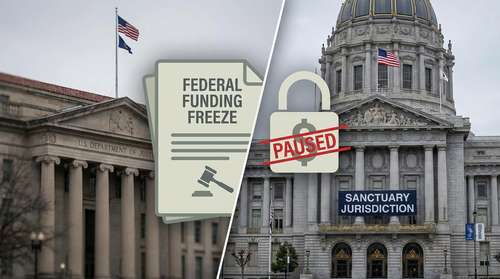
WASHINGTON D.C. — The standoff between the White House and Democratic-led states has reached a boiling point this week as the Trump administration officially initiated a sweeping freeze on federal payments to jurisdictions with "sanctuary" policies. Following a contentious February 1 deadline for compliance with new federal immigration cooperation mandates, the Department of Justice (DOJ) has begun withholding billions in grant money, sparking immediate legal retaliation from California, Illinois, and New York.
Federal Funding Cutoff Hits Critical Infrastructure
As of late February 2026, the Trump sanctuary city funding freeze has moved from threat to reality. State comptrollers in California and Illinois reported the first halted payments on Monday, affecting critical sectors ranging from highway maintenance to public safety grants. The Office of Management and Budget (OMB) confirmed that "non-compliant" jurisdictions—those refusing to grant ICE agents unrestricted access to local jails—are now ineligible for a wide swath of federal discretionary funds.
"We are enforcing the law," a White House spokesperson told reporters. "American tax dollars will not subsidize cities that release dangerous criminals back onto the streets rather than handing them over to federal authorities." The administration estimates that up to $7.6 billion in grants could be paused in the first quarter of 2026 alone, a move that governors warn could destabilize local economies and halt essential construction projects.
California and Illinois Lead Legal Counterstrike
The response from state leaders has been swift and aggressive. In a joint filing on Sunday, California Attorney General Rob Bonta and Illinois Attorney General Kwame Raoul sought an emergency injunction to block the federal grant cuts to sanctuary states. The lawsuit argues that the withholding of congressionally appropriated funds violates the separation of powers and the Tenth Amendment.
"This is not about immigration; this is an unconstitutional hostage-taking of our state's resources," California Governor Gavin Newsom stated in a press briefing in Sacramento. "We will not be bullied into commandeering our local law enforcement to do the federal government's bidding." The legal battle, dubbed California vs Trump immigration, is expected to reach the Supreme Court on an expedited track, given the immediate financial harm cited by the states.
DOJ Targets Mayors in New Wave of Lawsuits
Simultaneously, the DOJ sanctuary city lawsuits have expanded beyond broad funding freezes. Attorney General Pamela Bondi announced targeted litigation against the mayors of Los Angeles, Chicago, and Denver, accusing them of obstruction of justice for policies that forbid police from honoring ICE detainers. These civil suits seek not only to overturn local ordinances but to hold municipal officials personally liable for what the DOJ terms "harboring known fugitives."
ICE Detention Expansion and Refugee Scrutiny
Compounding the tension is the ICE detention expansion 2026 initiative, revealed in a Department of Homeland Security memo leaked earlier this week. The new directive grants ICE agents broader authority to detain lawful refugees who have not yet secured permanent residency if they are flagged for "security review." This policy shift has already led to reports of roving ICE patrols in Los Angeles and the creation of "ICE-free zones" by local municipalities attempting to shield residents from federal overreach.
Immigration advocacy groups have decried the move as a violation of international human rights protocols. "They are changing the rules of the game mid-play to target people who are here legally," said the director of the National Immigration Law Center. The administration counters that the 2026 immigration executive order provides the necessary legal framework to ensure national security remains paramount.
What’s Next for Sanctuary Jurisdictions?
As the Trump federal funding cutoff February saga unfolds, the immediate impact will be felt by local communities. Cities like San Francisco and Chicago are already drafting contingency budgets to cover the shortfall in federal aid. However, with the fiscal year closing in, the pressure on these "sanctuary" strongholds is mounting.
Legal analysts predict a protracted battle that could redefine the balance of power between the White House and state governments. If the courts side with the administration, it could mark the end of the sanctuary movement as it currently exists. If the states prevail, it would solidify the autonomy of local jurisdictions to set their own law enforcement priorities, dealing a significant blow to the President's second-term agenda.