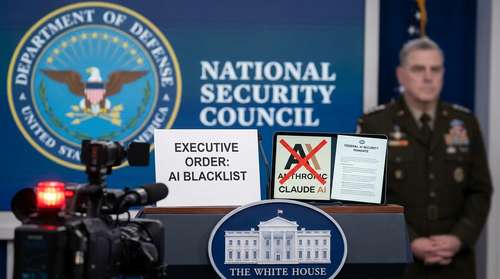
President Donald Trump has ordered an immediate halt to the use of Anthropic’s AI technology across all federal agencies, designating the San Francisco-based startup a "supply-chain risk to national security." The directive, issued Friday, marks a dramatic escalation in the ongoing conflict between the White House and the artificial intelligence sector. This unprecedented move effectively blacklists the makers of Claude AI from government contracts after the company refused to grant the Pentagon unrestricted access to its models, citing ethical red lines regarding mass surveillance and autonomous weaponry.
The Core Conflict: Safety Protocols vs. Unrestricted Access
The fracture between Washington and one of Silicon Valley’s leading AI labs centers on a fundamental disagreement over safety safeguards. The Pentagon, led by Defense Secretary Pete Hegseth, demanded that Anthropic remove specific "guardrails" from its Claude models to allow for "any lawful use" by the military. Anthropic CEO Dario Amodei refused to comply, drawing a firm line against two specific applications: mass domestic surveillance of American citizens and the deployment of fully autonomous weapons systems that can operate without human oversight.
"We cannot in good conscience accede to these demands," Amodei stated in a public response, emphasizing that the requested changes would fundamentally compromise the safety architecture of their AI systems. While Anthropic has previously collaborated with defense agencies for tasks like data analysis and cyber defense, the company argued that removing core safety protocols to allow for lethal autonomous decision-making crossed an ethical boundary they were unwilling to breach.
"Radical Left" Accusations and the Woke AI Narrative
President Trump responded to the refusal with characteristic vitriol on Truth Social, labeling Anthropic a "radical left" and "woke" company attempting to dictate terms to the U.S. military. "We don't need it, we don't want it, and will not do business with them again!" Trump declared. The administration's narrative frames safety limitations as ideological obstructionism, arguing that national security requires the military to have absolute control over the tools it employs, free from the "Silicon Valley ideology" of private tech firms.
Understanding the "Supply-Chain Risk" Designation
The most significant aspect of this ban is the formal designation of Anthropic as a "supply-chain risk." This legal mechanism has historically been reserved for foreign adversaries and companies deemed to be under the influence of hostile governments, such as Chinese telecommunications giant Huawei. Applying this label to a U.S.-based company is a historic first that carries severe economic consequences beyond just direct federal contracts.
Under this designation, not only are federal agencies barred from using Claude directly, but any government contractor or partner is also prohibited from maintaining commercial ties with Anthropic. This creates a massive ripple effect throughout the defense industrial base, forcing major integrators and cloud providers to choose between their federal contracts and their partnership with Anthropic. The order provides a six-month "phase-out" period for the Department of War (the administration's preferred name for the DoD) to transition off Anthropic's systems, acknowledging how deeply embedded the technology has already become in certain operations.
Legal Battles and Industry Implications
Anthropic has vowed to challenge the designation in federal court, calling the action "unprecedented" and "legally unsound." Legal experts suggest the administration may face an uphill battle in justifying a national security risk designation for an American company simply for refusing a contract modification. However, the immediate chilling effect on the AI industry is undeniable. Other major players may now feel pressured to preemptively remove safety restrictions to avoid similar retaliation.
This showdown sets a critical precedent for the future of AI governance. It forces a direct confrontation between the private sector's right to control their technology's ethical use and the state's demand for technological supremacy. As the six-month clock begins ticking for the Pentagon to replace Claude, the outcome of this clash will likely define the terms of engagement between Silicon Valley and Washington for the remainder of the Trump presidency.