
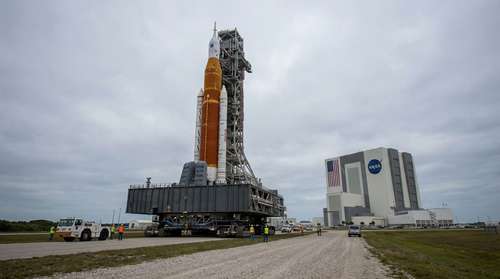
NASA has officially rolled the massive Artemis II Space Launch System (SLS) rocket back to the Vehicle Assembly Building (VAB), effectively closing the window for a February or March launch. The decision comes after engineers detected a persistent helium flow anomaly in the rocket's upper stage during final pre-launch testing at Kennedy Space Center. This critical hardware setback pushes the timeline for humanity's return to the Moon into April 2026 at the earliest.
Helium Issues Force Artemis II Rollback
The 322-foot-tall SLS rocket began its slow, four-mile journey from Launch Pad 39B back to the VAB on February 25, a process that took approximately 10 hours. Mission managers made the difficult call after a second "wet dress rehearsal"—a full countdown simulation—revealed irregular data in the helium pressurization system of the Interim Cryogenic Propulsion Stage (ICPS).
Helium is a crucial component in the SLS architecture, used to pressurize propellant tanks and purge engine lines of volatile gases. Unlike the liquid hydrogen leaks that plagued the uncrewed Artemis I mission, this issue involves the flow control of helium in the upper stage, a section of the rocket that is inaccessible while it sits on the mobile launcher at the pad.
"The safety of our crew is the paramount priority," NASA officials stated in a briefing following the rollback. "While the vehicle is in the VAB, teams will troubleshoot the helium flow issue, replace limited-life batteries in the Flight Termination System, and ensure every system is go for flight."
New Launch Window: Targeting April 2026
With the rocket now back in the hangar, the highly anticipated Moon mission 2026 schedule has shifted. Originally targeting a February launch, and briefly considering a March opportunity, NASA is now eyeing a launch window that opens no earlier than April 1, 2026.
The repair process is expected to take several weeks. Engineers must extend platforms inside the VAB High Bay 3 to access the ICPS, replace the faulty hardware, and conduct re-verification tests. Once the repairs are complete, the crawler-transporter will need to haul the massive stack back to the pad for final preparations.
Impact on the Artemis Timeline
This delay underscores the complexity of deep space exploration technology. Artemis II is a test flight in the truest sense, designed to stress-test the Orion spacecraft's life support systems with humans on board for the first time. The delay to April allows NASA to be methodical, avoiding the risks of rushing a mission that carries four astronauts.
Meet the Crew Waiting for Launch
While the rocket undergoes repairs, the four-person crew remains in pre-flight training. The mission will carry NASA astronauts Reid Wiseman (Commander), Victor Glover (Pilot), and Christina Koch (Mission Specialist), along with Canadian Space Agency astronaut Jeremy Hansen. They are slated to become the first humans to travel to the lunar vicinity since the Apollo 17 mission in 1972.
The crew has been released from their pre-launch quarantine following the delay announcement. They will continue simulation training at the Johnson Space Center until a new firm launch date is set. The Orion spacecraft status remains nominal (healthy), with the issues isolated strictly to the rocket's propulsion support systems.
What Happens Next at Kennedy Space Center?
Over the coming weeks, Kennedy Space Center news will focus heavily on the progress inside the VAB. The critical path to launch involves:
- Diagnosis: Pinpointing the exact valve or seal causing the helium flow restriction.
- Repair: Swapping out the affected component.
- Battery Replacement: Installing fresh batteries for the flight safety system, which have a limited certification lifespan.
- Retesting: Verifying the fix before rolling out to the pad for a third time.
While the delay is a disappointment for space enthusiasts hoping for a winter launch, the Artemis program is playing the long game. A successful Artemis II mission is the prerequisite for Artemis III, which aims to land the first woman and the first person of color on the lunar surface. By addressing the SLS rocket helium leak now, NASA is ensuring the foundation for sustained lunar exploration remains solid.