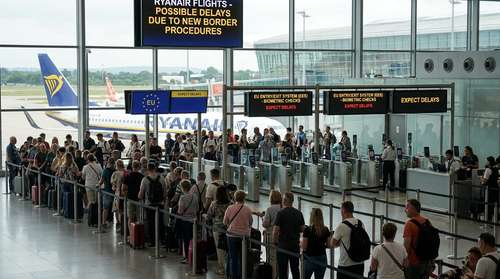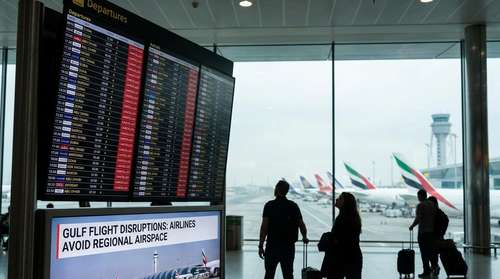
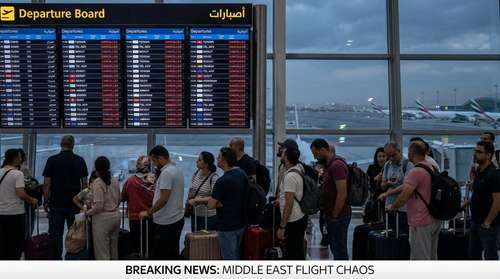
A massive wave of Middle East flight cancellations has paralyzed global air travel this weekend following joint U.S. and Israeli military strikes on Iran. The military action, which began in the early hours of Saturday, February 28, 2026, has triggered the immediate closure of critical airspace across the region, leaving thousands of passengers stranded and forcing a complete halt to operations at major global transit hubs.
Dubai Airport Suspended: Global Hubs Grind to a Halt
The impact on global aviation has been instantaneous and severe. Dubai airport suspended all flight operations shortly after the airspace closures were announced, effectively shutting down one of the world's busiest international gateways. Dubai International (DXB) and Dubai World Central (DWC) have both paused operations until further notice, creating a bottleneck for travelers connecting between Europe, Asia, and Africa.
Authorities in the United Arab Emirates, Qatar, Bahrain, Kuwait, and Iraq have issued urgent NOTAMs (Notice to Air Missions) closing their respective airspaces to civilian traffic. This coordinated shutdown has created a "no-fly zone" across a vast swathe of the Middle East, forcing long-haul flights currently in the air to divert or return to their points of origin. Flights from Australia to London and Toronto to Dubai were among dozens forced to perform mid-air U-turns hours into their journeys.
Doha and Abu Dhabi Join the Shutdown
The disruption is not limited to Dubai. Doha's Hamad International Airport (DOH), the home base of Qatar Airways, has also ceased operations following the closure of Qatari airspace. Similarly, flights to and from Abu Dhabi have been suspended, with Etihad Airways cancelling all departures until at least Sunday afternoon. The simultaneous closure of these three mega-hubs represents an unprecedented disruption to the modern aviation network.
Emirates Flight Status and Airline Responses
Travelers frantically checking their Emirates flight status are facing blanket cancellations. The Dubai-based carrier confirmed it has suspended all operations to and from its hub in response to the regional airspace closures. "We are actively monitoring the situation and engaging with relevant authorities," the airline stated, prioritizing the safety of passengers and crew above schedule adherence.
Other major regional carriers have followed suit:
- Qatar Airways has suspended all flights to and from Doha.
- Flydubai has grounded its entire fleet until further notice.
- Etihad Airways has cancelled all departures from Abu Dhabi for the next 24 hours.
International carriers are also scrambling to adjust. Lufthansa, Air France, British Airways, and United Airlines have all cancelled flights to Tel Aviv, Amman, and various Gulf destinations. The Iran Israel conflict travel impact is extending far beyond the immediate combat zone, with airlines avoiding the entire region to prevent accidental engagement with military assets.
Global Airline Disruptions and Airspace Closures Today
The airspace closures today have severed the primary air corridor connecting Europe and Asia. Typically, hundreds of wide-body aircraft pass over Iran and Iraq daily. With these routes now closed, airlines are being forced to route flights south over Saudi Arabia and Egypt—airspace that is becoming rapidly congested—or take much longer northern routes, adding hours to flight times and requiring costly fuel stops.
These global airline disruptions are expected to have a cascading effect on schedules worldwide for days, if not weeks. Analysts predict that even if airspace reopens quickly, the logistical challenge of repositioning displaced aircraft and crews will result in lingering delays. Ticket prices for available alternative routes are already surging as capacity plummets.
US Travel Advisory Middle East and Passenger Safety
In response to the escalating hostilities, the State Department has updated the US travel advisory Middle East guidance, urging American citizens to exercise extreme caution. The advisory warns of the potential for further military retaliation and sudden changes to airspace availability. Travelers currently in the region are advised to shelter in place and monitor local news, as commercial evacuation options are currently non-existent.
For those holding tickets, airlines are offering waivers and refunds, though rebooking options remain scarce. The situation remains fluid, and aviation authorities caution that the map of closed airspace could expand further depending on the trajectory of the conflict. Passengers are strongly advised not to go to airports unless their flight status is confirmed as operating.