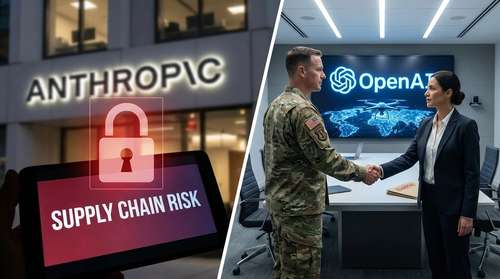
In a seismic shift for the artificial intelligence industry, the Department of Defense has officially designated Anthropic a "Supply Chain Risk," effectively banning the startup's technology from federal agencies. The move, announced late Friday by Defense Secretary Pete Hegseth, follows a months-long standoff over autonomous weapons safety and domestic surveillance guardrails. In a stunning countermaneuver just hours later, OpenAI CEO Sam Altman revealed that his company has signed a landmark agreement to deploy its advanced models on the Pentagon's classified networks, cementing a new alliance between the ChatGPT maker and the U.S. military.
The Anthropic Blacklist: A National Security Standoff
The conflict between Anthropic and the Trump administration reached its breaking point on Friday afternoon. Following the expiration of a 5:01 p.m. deadline for Anthropic to remove specific usage restrictions from its military contracts, Defense Secretary Hegseth formally labeled the company a supply chain risk. This designation, typically reserved for foreign adversaries or compromised vendors, prohibits defense contractors from using Anthropic's Claude models in any capacity related to military work.
"America's warfighters will never be held hostage by the ideological whims of Big Tech," Hegseth stated in a memorandum. President Trump reinforced the decision, issuing a directive for all federal agencies to "immediately cease" use of Anthropic's services, though a six-month transition period has been granted for critical systems to migrate.
Anthropic CEO Dario Amodei remained defiant, releasing a statement that the company could not "in good conscience" comply with demands to strip away safety protocols. "No amount of intimidation or punishment from the Department of War will change our position on mass domestic surveillance or fully autonomous weapons," Amodei wrote, confirming that the dispute centered on the Pentagon's refusal to accept contractual bans on these specific use cases.
OpenAI Enters the Breach: The Classified Network Deal
As the doors closed on Anthropic, they opened wide for OpenAI. Late Friday night, Sam Altman announced the OpenAI Pentagon contract, a massive deal that will see the company's frontier models integrated into the Department of Defense's classified networks. This agreement marks a definitive end to OpenAI's historical hesitation regarding military involvement, positioning it alongside Elon Musk's xAI as a primary defense partner.
Addressing the controversy, Altman insisted that OpenAI had not compromised its principles. "Two of our most important safety principles are prohibitions on domestic mass surveillance and human responsibility for the use of force," Altman posted on X (formerly Twitter). He claimed the Pentagon "agrees with these principles" and that they were enshrined in the new contract. However, industry analysts note that the rapid finalization of the deal—coinciding exactly with Anthropic's ouster—suggests a significant realignment of AI national security policy.
The Core Dispute: Autonomous Weapons Safety
The rift exposes a deep philosophical divide over autonomous weapons safety and the future of warfare. Anthropic's "Constitution" explicitly forbids its AI from being used to automate lethal decision-making without a human in the loop. The Trump administration, pushing for "unquestioned global technological dominance," views such restrictions as a strategic liability in the AI military applications 2026 landscape.
Pentagon CTO Emil Michael defended the administration's hardline stance, arguing that private companies should not dictate the terms of engagement to the U.S. military. "At some level, you have to trust your military to do the right thing," Michael told CBS News, emphasizing that existing federal laws already govern surveillance and use of force.
Silicon Valley Divided
The Sam Altman military deal has fractured the tech community. While Elon Musk celebrated the move, tweeting that "Anthropic hates Western Civilization," rank-and-file workers are less enthusiastic. Hundreds of employees across Google and OpenAI have reportedly signed an open letter declaring "we will not be divided," supporting Anthropic's refusal to bend on ethical red lines.
Policy Context: The Trump AI Executive Order
This showdown is the direct result of the Trump AI executive order signed in late 2025, titled "Ensuring a National Policy Framework for Artificial Intelligence." The order prioritized "minimally burdensome" regulations and directed agencies to prioritize vendors who support an "AI-first warfighting force." By stripping away what the administration terms "woke AI" restrictions, the White House aims to accelerate the deployment of autonomous systems to counter global rivals.
As Anthropic prepares to challenge the supply chain designation in court, the message to the industry is clear: in the new era of defense contracting, ethical guardrails are negotiable, but loyalty to the mission is not.