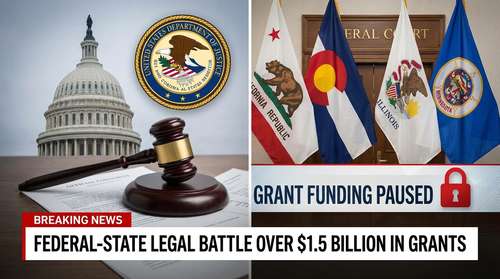
The Trump administration has escalated its conflict with Democratic leadership by moving to withhold approximately $1.5 billion in federal grants designated for California, Colorado, Illinois, and Minnesota. The directive, confirmed by officials on Tuesday, targets funding for transportation infrastructure and critical public health programs. The White House has cited unverified claims of "fraud and mismanagement" alongside assertions that the programs are "inconsistent with agency priorities." Democratic governors have immediately condemned the action as a calculated act of political retaliation, setting the stage for a high-stakes constitutional battle in federal court.
Targeting Public Health and Green Transit
The funding freeze specifically zeros in on grants administered by the Centers for Disease Control and Prevention (CDC) and the Department of Transportation. According to internal documents shared with congressional committees, roughly $600 million in public health funding is on the chopping block. These cuts jeopardize programs focused on HIV prevention, minority health equity, and modernized data systems for disease tracking. In California alone, nearly two-thirds of the targeted health funding consists of unspent money previously allocated to state and local health departments.
On the transportation front, the administration is withholding hundreds of millions of dollars intended for electric vehicle (EV) charging stations and climate resilience projects. Notably, the freeze also impacts a $7.2 million grant for the American Medical Association in Illinois, which the administration flagged for its support of gender-affirming care services. This precise targeting of initiatives linked to climate change and diversity, equity, and inclusion (DEI) suggests a strategy that goes beyond fiscal oversight to ideological dismantling.
"Inconsistent with Agency Priorities"
While the White House has publicly floated accusations of "blatant fraud" to justify previous funding pauses, the rationale for this latest tranche of cuts appears to be explicitly ideological. An Office of Management and Budget (OMB) official, speaking on condition of anonymity, confirmed that many of the grants were selected because they did not align with the new administration's policy goals. The Department of Health and Human Services (HHS) echoed this sentiment, stating that the terminated grants "do not reflect agency priorities"—a phrase that has become a euphemism for programs supporting LGBTQ+ communities and racial equity initiatives.
The administration's approach attempts to bypass the traditional impoundment restrictions that require congressional approval to cancel funding. By labeling the grants as mismanaged or misaligned, the executive branch is testing the limits of its authority to unilaterally defund programs already appropriated by Congress. This move follows a similar, broader attempt last month to freeze $10 billion in social service funding, which a federal judge temporarily blocked, signaling that the courts may once again be the final arbiter.
Democratic Governors Strike Back
The reaction from the affected states was swift and unified. Democratic leaders accuse President Trump of weaponizing the federal bureaucracy to punish political opponents ahead of the 2026 midterms. California officials, familiar with legal skirmishes from the first Trump term, labeled the move "reckless and irresponsible." In a statement, Speaker Emerita Nancy Pelosi called the justification a "transparent excuse to punish states and communities it disagrees with," warning that lives would be lost due to the disruption of disease surveillance and prevention networks.
Illinois Governor J.B. Pritzker and Colorado Governor Jared Polis have also signaled their intent to fight the cuts. State attorneys general are preparing to file emergency motions, arguing that the executive branch cannot refuse to spend money that Congress has lawfully appropriated. The legal argument will likely hinge on the Impoundment Control Act of 1974, which was designed specifically to prevent presidents from unilaterally withholding funding for policy reasons. "This is not about fraud; this is about retribution," said one senior aide to Governor Tim Walz of Minnesota.
Implications for 2026 and Federalism
This $1.5 billion freeze represents a significant escalation in the struggle between state sovereignty and federal power. By targeting specific "blue states" that have served as bulwarks against his agenda, President Trump is effectively creating a two-tiered system of federal support. The outcome of this standoff will have profound implications for the 2026 political landscape, potentially reshaping how federal grants are distributed and whether partisan allegiance becomes a prerequisite for receiving taxpayer dollars.
As the legal challenges mount, the immediate impact will be felt by local communities relying on these funds for everything from clean buses to mental health services. With the administration showing no signs of backing down, the courts will soon decide whether the President's power of the purse is absolute or if the separation of powers still holds firm.