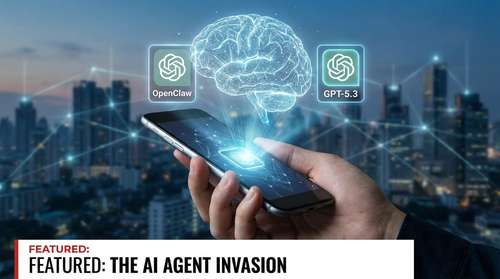
The era of the application is over; the era of the agent has begun. In a week that will likely be remembered as the turning point for personal computing, two massive developments have collided to dismantle the traditional app ecosystem: the viral explosion of the OpenClaw autonomous AI framework and the enterprise-grade dominance of the newly released OpenAI Frontier service. As of February 22, 2026, the tech world is no longer talking about chatbots or copilots. We are witnessing a full-scale invasion of autonomous AI assistants capable of executing complex, multi-step workflows without human intervention. The implications are immediate and disruptive: why open an app when an agent can do the work for you?
OpenClaw: The Open-Source Rebel Redefining Sovereignty
While corporate giants battle for cloud supremacy, a grassroots revolution has taken over the developer community. OpenClaw autonomous AI, a local-first agentic framework, has surpassed 175,000 GitHub stars in mere weeks, a trajectory that eclipses even the original release of Bitcoin. Originally developed by Peter Steinberger as "Clawdbot," the tool has become the de facto standard for agentic AI technology running on consumer hardware.
Unlike its predecessors, OpenClaw doesn't live in a web browser. It runs as a background daemon on your local machine, using secure messaging platforms like Signal or Telegram as its command interface. Users are reporting that OpenClaw can independently negotiate insurance claims, reorganize local file systems, and even rebuild entire websites via simple text commands while the user sleeps. This "headless" operation marks a critical shift in 2026 tech trends: the user interface is disappearing, replaced by outcome-oriented instruction.
Enter 'Garlic': The GPT-5.3 Release Changes Everything
Just as the open-source community rallied around OpenClaw, OpenAI dropped its own bombshell with the GPT-5.3 release, internally codenamed "Garlic." Moving away from the "bigger is better" dogma, GPT-5.3 focuses on "cognitive density"—packing superior reasoning capabilities into a more efficient architecture. The model, which powers the new OpenAI Frontier service, boasts a massive 128,000-token output limit, allowing it to generate entire software suites or 100-page technical manuals in a single pass.
The Frontier platform, widely rolled out to enterprises this week, allows companies to "hire" AI coworkers—persistent, distinct digital employees with their own memories and permissions. Early reports from beta testers suggest that Frontier agents are already displacing Tier-1 support and junior analyst roles at a pace that has regulators scrambling. Unlike the chaotic energy of OpenClaw, Frontier offers a sanitized, controlled environment for autonomous AI assistants, creating a bifurcation in the market between the "wild west" of local agents and the walled gardens of corporate AI.
The Death of the Interface
The common thread connecting OpenClaw and GPT-5.3 is the obsolescence of the graphical user interface (GUI). For decades, humans have adapted to computers by learning to navigate menus, click buttons, and switch between apps. AI agents invert this relationship. By interacting directly with APIs and the Document Object Model (DOM), agents like OpenClaw bypass the "user" experience entirely.
Security researchers are already sounding alarms about this new paradigm. With the discovery of CVE-2026-25253—a vulnerability in OpenClaw's WebSocket handling—the risks of giving autonomous agents root access to local systems have become terrifyingly real. Yet, the convenience of "set and forget" workflows is proving too addictive to resist. We are trading control for autonomy, moving toward a future where our devices are less like tools and more like black boxes that simply "get things done."
The New Service-as-an-Agent Economy
This shift is rapidly creating a new economic model. SaaS (Software as a Service) is being cannibalized by "Service-as-an-Agent." Why pay for a monthly subscription to a project management tool when an instance of OpenAI Frontier service can dynamically track, assign, and verify tasks via email and Slack without a dedicated UI? The disruptive force of agentic AI technology is not just in automation, but in the erasure of the friction that previously justified the existence of thousands of B2B applications.