The AI Impact Summit 2026 concluded in New Delhi yesterday with a seismic shift in the global technology landscape. In a historic move, 70 nations formally adopted the Delhi Declaration AI, while a consortium of tech giants and sovereign funds announced a staggering $250 billion commitment to AI infrastructure investment. Yet, the summit’s final moments were overshadowed by a visible frost between the industry’s two most powerful figures—OpenAI’s Sam Altman and Anthropic’s Dario Amodei—whose intensifying Sam Altman Dario Amodei feud has now spilled from Super Bowl ad breaks onto the geopolitical stage.
The Photo Op Heard 'Round the World
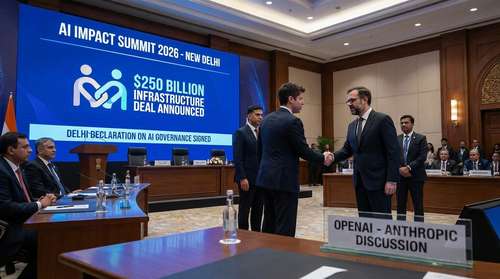
The summit’s closing ceremony was intended to project unity, but it instead highlighted the deep fracture at the heart of the OpenAI vs Anthropic rivalry. As Indian Prime Minister Narendra Modi attempted to raise the hands of the assembled tech leaders in a traditional show of solidarity, Altman and Amodei—positioned side-by-side—refused to clasp hands. Instead, both CEOs raised clenched fists, creating a disjointed image that immediately went viral as a symbol of the new "AI Cold War."
"I was sort of confused," Altman later told reporters, attempting to downplay the incident. "Modi grabbed my hand... I wasn't sure what we were supposed to be doing." However, industry insiders view the moment as a deliberate snub following Anthropic’s aggressive Super Bowl commercial earlier this month, which attacked OpenAI’s commercialization strategy with the tagline: "Ads are coming to AI. But not to Claude." Altman had previously dismissed the campaign as "clearly dishonest," but the tension in New Delhi suggests the animosity has hardened into a bitter personal and ideological schism.
$250 Billion for the 'Intelligence Revolution'
Beyond the personal drama, the summit delivered the largest coordinated capital injection in tech history. The headline $250 billion infrastructure deal aims to build the physical backbone required for the next generation of frontier models. The massive package includes a $100 billion pledge from the Adani Group to develop renewable-powered hyperscale data centers across the Global South and a $50 billion commitment from Microsoft to expand sovereign compute capacity.
"We are shifting from the era of software to the era of sovereign intelligence," noted an analyst from Menlo Ventures. The deal underscores a critical pivot: as model training costs skyrocket, the barrier to entry is no longer just talent, but energy and steel. The investment also includes a major partnership between the Tata Group and OpenAI to deploy GPT-5.3-Codex across India’s enterprise sector, a direct counter-move to Anthropic’s surging dominance in the corporate market.
The Delhi Declaration: A New Global Rulebook?
While the cash grabbed headlines, the signing of the Delhi Declaration AI represents the most significant step forward in global AI regulation news since the Bletchley Park summit. Signed by 70 nations, the declaration establishes "shared language" for defining unacceptable AI risks, specifically targeting biological threats and autonomous weaponry. Unlike previous non-binding agreements, the Delhi text includes provisions for a global "kill switch" protocol for models that demonstrate deceptive behavior.
"We are entering an era where humans and intelligence systems co-create and co-evolve," Prime Minister Modi stated during the signing. "We must resolve that AI is used for the global common good." The declaration is seen as a victory for the "safety-first" bloc, heavily lobbied for by Amodei’s Anthropic, which recently donated $20 million to pro-regulation political action committees in Washington.
Battle of the Models: Opus 4.6 vs. GPT-5.3
The geopolitical maneuvering is being driven by rapid acceleration in the labs. Just days before the summit, both companies released model updates that define their diverging philosophies. Anthropic’s Claude Opus 4.6 has been lauded for its massive context window and safety guardrails, helping the company capture a reported 40% of the enterprise market in late 2025. In contrast, OpenAI’s new GPT-5.3-Codex focuses on raw speed and agentic coding capabilities, aiming to regain the developer hegemony that has slipped in recent months.
Future of AI Governance
As the delegates depart New Delhi, the future of AI governance looks increasingly bipolar. On one side stands the OpenAI-Microsoft alliance, pushing for rapid acceleration, "sovereign AI" for nations, and massive energy infrastructure. On the other lies the Anthropic-backed safety coalition, advocating for strict liability and slowing down the race to AGI. The Delhi summit proved that while the world can agree on the need for infrastructure, the philosophical war over how to build the "mind" of the machine is only just beginning.