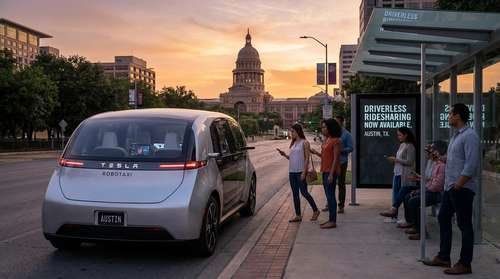
The era of fully autonomous transport has officially arrived in Texas. On Thursday, Tesla officially deployed its first commercial robotaxi fleet in Austin without human safety monitors, marking a historic turning point for the company’s autonomous ambitions. For the first time, everyday riders in the Texas capital can hail a Tesla Model Y that arrives with an empty driver’s seat, signaling the transition of Full Self-Driving (FSD) from a driver-assist feature to a legitimate commercial driverless service.
The Driverless Reality: Inside the Austin Launch
The milestone was confirmed late Thursday by CEO Elon Musk, who shared footage of the driverless vehicles navigating Austin’s complex urban streets. While Tesla has been testing its autonomous ride-sharing network in Austin since mid-2025, previous iterations always required a ‘safety monitor’ seated in the front to intervene if necessary. That safety net has now been removed for a select portion of the fleet.
According to Ashok Elluswamy, Tesla’s Director of Autopilot Software, the rollout is being executed with a calculated ‘mixed fleet’ strategy. Currently, a small number of completely unsupervised vehicles are operating alongside the broader fleet that still retains human monitors. “The ratio of unsupervised vehicles will increase over time as we validate performance at scale,” Elluswamy noted, emphasizing a data-driven approach to expanding the service.
How the Service Works
Residents in downtown Austin can access the service via the Tesla app, which now functions similarly to competitors like Uber or Waymo. When a user requests a ride, the app notifies them if they have been matched with a fully driverless ride-sharing vehicle. Early reports from riders describe the experience as surreal yet smooth, with the modified Model Ys handling intersections, pedestrians, and traffic lights with confident precision.
FSD 2026: Technology Meets Commercial Strategy
This launch represents the culmination of years of training for Tesla FSD 2026. By removing the driver, Tesla is effectively declaring that its AI stack has reached Level 4 autonomy in vetted geofenced areas. This move significantly alters the liability landscape; for these specific autonomous trips, Tesla is assuming responsibility for the vehicle's operation, a step the company had previously been hesitant to take.
To support this shift, insurance disruptor Lemonade has announced a strategic partnership with Tesla to provide specialized coverage for the autonomous fleet. This collaboration validates the safety data underpinning the self-driving car milestone, suggesting that third-party actuaries are finally comfortable underwriting Tesla’s vision of a crash-free future.
Market Reaction and The Road Ahead
Wall Street reacted positively to the Elon Musk Tesla news, with TSLA stock jumping approximately 4% following the announcement. Investors view this deployment as critical proof-of-concept before the company’s purpose-built robotaxi, the ‘Cybercab,’ enters limited production, which is slated for April 2026.
While competitors like Waymo and Zoox have operated driverless fleets for years, Tesla’s approach differs fundamentally. Instead of relying on expensive LIDAR and high-definition maps, the Tesla Austin fleet relies entirely on camera-based vision and neural networks. If this low-cost hardware approach proves safe at scale in Austin, it could pave the way for rapid expansion to other cities, potentially undercutting current market rates for autonomous rides.
As the autonomous taxi launch gains momentum, all eyes will be on the fleet's safety performance over the coming weeks. For now, however, the empty driver's seat in Austin stands as tangible proof that Tesla’s long-promised robotaxi future is no longer just a concept—it is on the road.