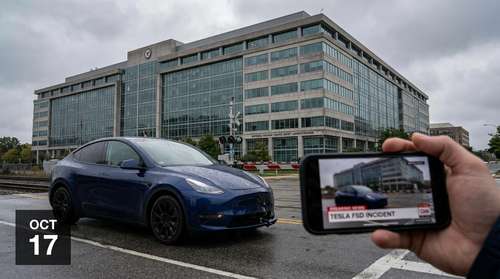
The timing is almost too poetic for critics of autonomous driving. Just as Tesla faces a pivotal March 9, 2026, deadline to submit extensive crash data to federal regulators, a terrifying new video has emerged. Dashcam footage capturing a catastrophic Tesla FSD failure in the Los Angeles area is sweeping across social media, showing a Model 3 plowing directly into active railroad crossing barriers. The incident underscores mounting concerns over autonomous vehicle safety at the exact moment the government is demanding concrete answers.
The Viral Tesla Railroad Crossing Video Explained
The footage, originally uploaded to the platform Threads by Tesla owner Laushi Liu on Sunday, March 8, shows the vehicle traveling at 23 mph in West Covina, California. Operating on the company’s "Full Self-Driving" system, the car approaches a railroad intersection where the red-and-white warning barriers are fully lowered. Rather than decelerating, the software completely fails to register the physical obstruction in its path.
The Tesla railroad crossing video reveals the car driving straight through the gates, shattering them upon impact. While the driver reportedly applied the brakes at the last possible second, the human intervention was simply too late to prevent the collision. The visual is particularly damning because the lowered barriers sat squarely at the height of the vehicle's front-facing cameras. This blind spot isn't entirely unprecedented. There have been prior documented incidents of the software struggling to navigate train crossings, including a notable Pennsylvania collision where a Model 3 actually turned onto active train tracks. However, the vivid clarity of the West Covina footage has reignited fierce debates over the system's reliability in sudden, life-or-death scenarios.
Inside the NHTSA Tesla Investigation and March 9 Deadline
This viral crash perfectly encapsulates the core focus of the ongoing NHTSA Tesla investigation. In October 2025, the National Highway Traffic Safety Administration launched a sweeping probe into roughly 2.88 million FSD-equipped vehicles. The agency initially connected 58 incidents to the software, a number that rapidly ballooned to over 80 documented traffic violations, including 14 crashes and 23 injuries by late 2025.
Today marks the final Tesla data deadline after the automaker secured two previous extensions from original January 19 and February 23 dates. Regulators aren't just looking for standard accident reports. They are demanding highly granular telemetry, including second-by-second pre-crash timelines starting 30 seconds before an event. The agency expects full Event Data Recorder (EDR) and CAN bus files to determine exactly what the vehicle's cameras perceived, what the path-planning algorithms intended to do, and whether human drivers were issued appropriate warnings. Tesla previously claimed it needed the extra extensions to manually review over 8,300 complex incident records, noting their engineering teams could only process about 300 per day.
The Heavy Cost of Non-Compliance
Failure to meet today's data submission requirements could trigger severe financial and operational consequences. The federal government possesses the authority to levy fines of roughly $28,000 per day, capping out at $139.4 million. More critically, if the submitted data proves that these software blind spots are systemic, regulators could mandate a massive safety recall, potentially restricting where and how the technology can be activated in the future.
Looming Shifts in Self-Driving Car Regulations
This convergence of a high-profile crash and federal scrutiny represents a watershed moment for self-driving car regulations. Despite its ambitious name, the software remains a Level 2 driver-assistance system, legally requiring a human to remain attentive and keep their hands on the steering wheel. Yet, the marketing terminology continues to draw intense regulatory fire. In February 2026, the California DMV ruled that the "Full Self-Driving" moniker was inherently misleading, forcing the company to alter its branding within the state.
Safety advocates argue that humans are fundamentally ill-equipped to babysit partially automated systems. When a vehicle flawlessly handles 99% of a daily commute, drivers naturally become complacent. If the software abruptly fails to detect a literal barrier at eye level, human reaction times are rarely swift enough to step in and prevent a collision, a core behavioral concern the NHTSA is heavily evaluating.
What This Means for Elon Musk Tesla News
For investors and tech enthusiasts following Elon Musk Tesla news, the stakes have rarely been higher. The company's massive market valuation is heavily tethered to the promise of solving unsupervised autonomy and scaling a highly profitable robotaxi network. Since launching an unsupervised robotaxi service in mid-2025, the company has reported 14 incidents involving those vehicles, keeping the rollout under significant pressure. Musk has consistently touted the safety metrics of his vehicles, claiming that supervised FSD drivers travel millions of miles between major crashes.
However, critics and crash investigators point out that these figures can be misleading. They argue that the system is primarily deployed in favorable weather and predictable highway conditions, whereas national crash averages include all types of hazardous driving, such as intoxicated or distracted drivers. As engineers rush to finalize their data transmission to Washington today, the public is left watching a shattered crossing gate in Los Angeles. Whether this critical data drop validates the automaker's algorithmic progress or gives the NHTSA the ammunition to restrict the software will fundamentally shape the future of American transportation.