
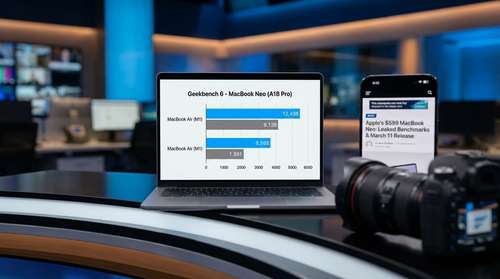
Apple’s historic March hardware reveal has sent shockwaves through the tech industry, not for a new high-end Pro device, but for a $599 laptop that changes the rules of the game. As pre-orders surge ahead of the March 11 shipping date, leaked MacBook Neo benchmarks confirm that Apple’s boldest experiment yet—putting an iPhone processor inside a Mac—is a resounding success. The data suggests this cheapest MacBook ever isn't just a bargain; it’s a legitimate powerhouse that surprisingly outpaces the M1 MacBook Air in key metrics.
MacBook Neo Benchmarks: A-Series Chip Defies Logic
The skepticism surrounding the MacBook Neo’s reliance on the A18 Pro chip (originally designed for the iPhone 16 Pro) has evaporated overnight. Early Geekbench scores obtained by Newsvot reveal a Single-Core score of approximately 3,461 and a Multi-Core score of 8,668. For context, the legendary M1 MacBook Air averages around 2,346 in single-core performance. This means the $599 Neo is roughly 47% faster in single-threaded tasks than the laptop that redefined Apple Silicon just six years ago.
“This is the budget gamble paying off,” says tech analyst Sarah Jenkins. “Apple has effectively recycled its mobile silicon to destroy the sub-$600 laptop market.” While the Neo lacks the raw multi-core graphical power of the M5 series found in the new MacBook Pros, its Metal score of 31,286 proves it is more than capable of handling everyday photo editing, 4K streaming, and student workloads without breaking a sweat.
Design and Compromises: The $599 Reality
To hit the aggressive Apple budget laptop 2026 price point, Cupertino made calculated cuts. The MacBook Neo features a 13-inch Liquid Retina display with a thicker bezel and no notch—a design choice many purists might actually prefer. It comes in four playful colors: Indigo, Blush, Citrus, and Silver, clearly targeting the student and casual user demographic.
However, prospective buyers should note the connectivity limits. The device sports just two USB-C ports (one USB 3 speed, one USB 2) and relies on USB-C for charging, skipping the beloved MagSafe connector found on pricier models. Furthermore, the base $599 model lacks Touch ID; you’ll need to shell out $699 for the 512GB model to get the fingerprint sensor. Despite these omissions, the chassis remains premium aluminum, weighing just 2.7 pounds—identical to the Air.
iPhone 17e Price and Specs: The Other Budget Hero
Sharing the spotlight is the iPhone 17e, which also ships next week. Apple has corrected the missteps of the 16e by doubling the base storage to 256GB while keeping the price at a competitive $599. Powered by the new A19 chip and Apple’s proprietary C1X modem, the 17e offers 5G speeds reported to be twice as fast as its predecessor.
MagSafe Returns
Perhaps the biggest win for budget tech reviews is the return of MagSafe to the ‘e’ line. The iPhone 17e supports the full ecosystem of magnetic accessories and 15W wireless charging. While it retains a notch (skipping the Dynamic Island) and a single 48MP rear camera, the inclusion of the Ceramic Shield 2 display makes it the most durable budget iPhone to date.
MacBook Neo vs MacBook Air: Which Should You Buy?
The MacBook Neo vs MacBook Air debate is now the primary question for consumers. If your workflow involves heavy video rendering or code compilation, the M-series MacBook Air (now repositioned as a mid-range option starting at $999) remains superior due to better thermal management and multi-core scaling. However, for 90% of users—students, writers, and web browsers—the MacBook Neo offers comparable real-world speed for nearly half the price.
This Apple March 2026 event news signals a paradigm shift. By bifurcating its lineup into “A-series Consumer” and “M-series Pro,” Apple isn't just competing with Windows laptops and Chromebooks; it’s looking to extinguish them entirely.