The rapidly escalating conflict between the United States, Israel, and Iran has triggered an unprecedented crisis in the skies, paralyzing international transit and leaving millions of travelers in limbo. As of March 9, Middle East flight cancellations 2026 have surpassed a staggering 32,500 grounded flights, sending shockwaves through the global transportation ecosystem. With ballistic missiles and drones crossing major civilian flight paths over the past week, aviation authorities have been forced to shut down vast expanses of airspace, effectively severing the primary aviation corridor connecting Europe, Asia, and Africa.
Global Aviation Disruption Reaches Breaking Point
The scale of this global aviation disruption is historic, dwarfing previous regional crises. Following the coordinated U.S.-Israeli strikes on Iranian leadership and Tehran's retaliatory bombardments across the Gulf, commercial airlines have completely redrawn their operational maps. Aviation analytics firm Cirium reports that at the peak of the crisis, more than six in ten scheduled departures in the affected zones were wiped from the boards. Industry giants like Emirates, Qatar Airways, and Lufthansa have grounded fleets or suspended operations indefinitely across key Middle Eastern destinations.
The US Iran war travel impact extends far beyond the immediate combat theater. Carriers that rely on the Gulf as a transcontinental bridge are now scrambling to find alternative paths. This sudden evaporation of capacity has led to skyrocketing ticket prices on routes linking Asia and Europe, with booking platforms showing near-term flights fully sold out and remaining economy seats commanding premium fares.
Airline Rerouting Conflict Zones
Safety agencies, including the European Union Aviation Safety Agency (EASA) and the U.S. Federal Aviation Administration (FAA), have issued high-risk advisories for the region. In response, carriers are heavily engaged in airline rerouting conflict zones. Flights that once glided over the Persian Gulf are now being pushed on arduous detours through Central Asia or southward over Egypt and Oman. These extended flight paths not only require costly technical fuel stops but severely strain global fleet availability and crew scheduling.
The crisis is also paralyzing global supply chains. Because the majority of international air cargo is carried in the belly-hold of commercial passenger planes, the grounding of major Gulf fleets has caused an instant bottleneck for global freight. Airlines like Cargolux have essentially halted regional operations, while Qatar Airways Cargo attempts to run limited freighter networks positioned outside of Doha. Consequently, the combination of restricted airspace and the closure of maritime routes like the Strait of Hormuz has sent global oil prices surging above $85 per barrel.
The Dubai International Airport Closure
At the center of the logistical nightmare is the unprecedented Dubai International Airport closure. Normally handling over 1,000 flights daily and serving as the world's busiest international passenger hub, the facility suspended operations after Iranian drone and missile strikes breached UAE airspace. While a strictly controlled emergency corridor has allowed a trickle of repatriation flights over the last week—evacuating around 17,500 passengers—routine commercial operations remain entirely suspended.
The sudden shutdown of such a critical artery has created a severe bottleneck. Neighboring hubs in Doha, Abu Dhabi, and Bahrain have also seen dramatic reductions in departure volumes. Qatar Airways temporarily suspended its entire network pending safety reviews, while Air India took the extraordinary step of halting all flights to the Middle East indefinitely. Transit points outside the immediate danger zone, such as Muscat, Oman, are completely overwhelmed trying to accommodate diverted aircraft and displaced crews.
Millions of Stranded Passengers Middle East and Beyond
On the ground, the human toll of the airspace closures is mounting. There are currently over a million stranded passengers Middle East-wide, ranging from corporate executives and holidaymakers to international sports teams. For instance, Zimbabwe's national cricket team remains stuck in transit following their T20 World Cup commitments, illustrating how far-reaching the operational paralysis has become.
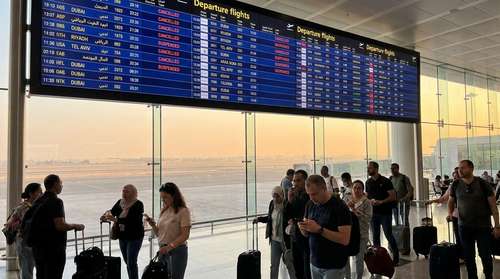
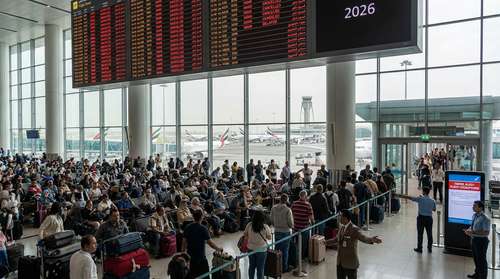
Travelers trapped in major transit hubs report blank arrival boards, overwhelmed customer service desks, and a severe shortage of hotel accommodations. For anyone navigating the Middle East flight cancellations 2026 landscape, securing alternative transport has become a monumental challenge. While the UAE government and some airlines are attempting to cover costs for displaced travelers, the sheer volume of people caught in the crossfire makes comprehensive relief nearly impossible until full commercial schedules resume.
Strict Travel Warnings March 2026
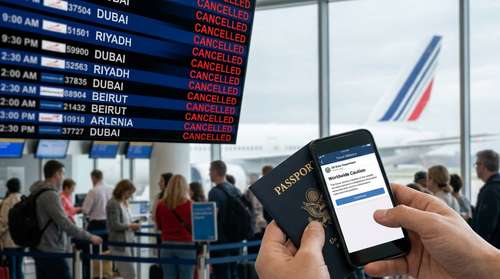
As the geopolitical situation deteriorates, governments worldwide are taking drastic diplomatic steps. The U.S. State Department issued stringent travel warnings March 2026, elevating the risk levels for nine countries across the region and urging Americans to depart immediately via any available commercial or ground transport. For those trapped inside Iran, authorities have advised citizens to shelter in place or attempt land border crossings into neighboring Armenia or Azerbaijan, though these routes remain heavily congested and legally precarious for dual nationals.
Tourism economists predict the ripple effects of this week's crisis will devastate the region's hospitality sector, potentially erasing up to $56 billion in visitor spending by the end of the year. The long-term economic fallout of the Middle East flight cancellations 2026 will be felt across global supply chains and international tourism markets alike. Until a diplomatic breakthrough secures the airspace, passengers worldwide must brace for prolonged volatility, inflated fares, and the continuous threat of sudden schedule changes.