
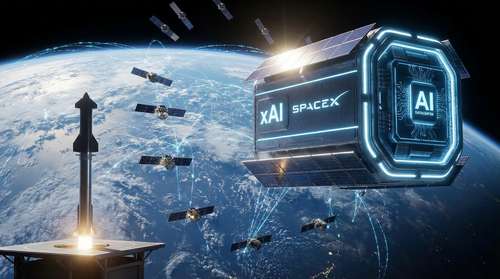
In a move that fundamentally reshapes the future of technology and aerospace, SpaceX has officially announced the acquisition of xAI in a landmark merger valuing the combined entity at approximately $1.25 trillion. Announced on Monday, February 2, 2026, this historic deal unites Elon Musk's premier ventures into a single vertically integrated powerhouse aimed at overcoming Earth's energy limitations by deploying space-based AI datacenters. By integrating the reasoning capabilities of the Grok AI model with the orbital infrastructure of Starlink, the merger sets the stage for a new era of off-world computing.
The $1.25 Trillion Deal: A New Industrial Titan
The acquisition, finalized via a massive stock swap, consolidates two of the world's most valuable private companies. Market analysts report that the deal values SpaceX at roughly $1 trillion and xAI at approximately $250 billion. This strategic consolidation brings together the launch capacity of Starship, the global connectivity of Starlink, and the cutting-edge artificial intelligence of xAI under one roof.
"SpaceX has acquired xAI to form the most ambitious, vertically-integrated innovation engine on (and off) Earth," Musk stated in the official announcement on the SpaceX website. This merger is widely seen as a precursor to a highly anticipated initial public offering (IPO) expected later this year, potentially positioning the combined entity as the most valuable company in history upon its public debut.
Unifying the Musk Ecosystem
This merger is the culmination of a broader consolidation strategy. With xAI having previously acquired the social media platform X (formerly Twitter) in 2025, the new conglomerate now controls a complete ecosystem: data generation (X), model training (xAI), and global distribution infrastructure (SpaceX/Starlink). The deal also follows a recent $2 billion investment from Tesla into xAI, further intertwining Musk's public and private business interests.
Orbital Data Centers: Solving the AI Energy Crisis
The primary driver behind this SpaceX xAI merger is a critical engineering challenge: the insatiable energy demand of next-generation artificial intelligence. As terrestrial datacenters strain global power grids, Musk is betting that the solution lies in orbit. The announcement explicitly highlighted plans to build "orbital data centers"—satellites equipped with high-performance inference compute clusters powered directly by unfiltered solar energy.
"Current advances in AI are dependent on large terrestrial datacenters, which require immense amounts of power and cooling," the company's statement read. "Global electricity demand for AI simply cannot be met with terrestrial solutions... The only logical solution therefore is to transport these resource-intensive efforts to a location with vast power and space."
The Role of Starship and Starlink
SpaceX's Starship rocket will play a pivotal role in this vision. The massive launch vehicle is the only transport system capable of lifting the heavy infrastructure required for these space-based datacenters. The plan involves launching a constellation of specialized satellites that will integrate with the existing Starlink network, creating a mesh of high-speed connectivity and orbital compute power. This infrastructure will allow the Grok AI models to scale beyond the thermal and power limits of Earth-based facilities.
Tech Industry News 2026: What This Means for the Future
This merger signals a major shift in the tech industry news 2026 landscape, moving the battle for AI dominance from Silicon Valley server farms to Low Earth Orbit (LEO). Competitors like Google and Microsoft are now facing a rival that owns not just the AI models, but the physical infrastructure to power and deploy them globally without reliance on municipal power grids.
Analysts suggest that space-based AI datacenters could offer a significant competitive advantage. "In the long term, space-based AI is obviously the only way to scale," Musk noted, predicting that within two to three years, the most cost-effective way to generate AI compute will be in space. If successful, this bold strategy could redefine the economics of artificial intelligence, making the SpaceX xAI acquisition a turning point in human technological history.