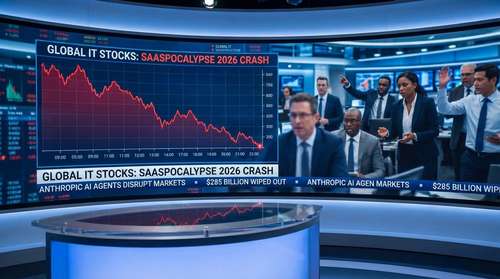
Global technology markets are reeling today in what analysts are already calling the "SaaSpocalypse 2026." In a stunning display of tech market volatility, software and IT services stocks worldwide suffered their steepest single-day decline since the 2020 crash, wiping out an estimated $285 billion in market value. The sell-off was triggered by the release of Anthropic's latest autonomous Anthropic AI agent release—a suite of plugins for its "Claude Cowork" platform that investors fear will render the traditional seat-based Software-as-a-Service (SaaS) business model obsolete.
The Anthropic Shock: Agents That Do the Work
The catalyst for today's global software stock crash was Anthropic's announcement of 11 new open-source plugins for its Claude Cowork platform. Unlike previous AI iterations that acted as assistants, these new agents are designed to autonomously execute complex professional workflows—from legal contract review to enterprise sales prospecting—without human intervention.
Industry experts note that this release marks a fundamental shift from "copilots" to fully autonomous workers. "This isn't just about efficiency anymore; it's about replacement," says a lead analyst at a major Silicon Valley firm. "If a single AI agent can manage the workflow of five junior employees, the need for multiple SaaS licenses evaporates." The new agents utilize Anthropic's Claude Opus 4.5 architecture, allowing them to navigate third-party software interfaces, manage files, and complete end-to-end tasks that previously required human oversight and multiple software subscriptions.
Market Bloodbath: Billions Wiped Out in Hours
The market reaction was swift, brutal, and indiscriminate. Wall Street saw a massive exodus from cloud and software giants. High-profile stocks like Salesforce, ServiceNow, and Adobe plummeted between 6% and 10% as investors reassessed their long-term growth prospects. Legal tech firms faced even steeper losses, with companies like LegalZoom and Thomson Reuters seeing double-digit declines following the debut of Claude's specialized legal agent.
The IT services sell-off was equally severe in international markets. In India, the Nifty IT index news was dominated by a 7% plunge, the sector's worst performance in nearly six years. Heavyweights like Infosys, TCS, and Wipro—whose business models rely heavily on human capital for code maintenance and business process outsourcing—were hammered by fears that autonomous agents could automate the very services they export. "The market is pricing in a structural reset," noted Jeffrey Favuzza of Jefferies, who coined the term "SaaSpocalypse" to describe the panic.
Why Investors Are Panicking
The core of the anxiety lies in the potential collapse of the "per-seat" pricing model. For two decades, SaaS companies have grown by selling subscriptions based on the number of human users. If AI agents reduce the human headcount required to do the same amount of work, revenue for these software giants could contract significantly. This AI disruption business news suggests a future where companies pay for outcomes rather than tools, fundamentally upending the valuations of the world's largest software companies.
A New Era or Overreaction?
While the market rout suggests doom, some observers believe the sell-off may be an overreaction. Proponents of the new technology argue that while the SaaSpocalypse 2026 reflects valid fears, it also signals a massive productivity boom. Anthropic has emphasized that its tools are designed to handle repetitive "drudge work," freeing humans for higher-value tasks. However, in the short term, uncertainty rules the trading floor.
As the dust settles on this historic trading day, one thing is clear: the AI revolution has moved from a theoretical future to a concrete financial reality. Companies across the IT spectrum will now face intense pressure to prove their relevance in a world where software can drive itself.