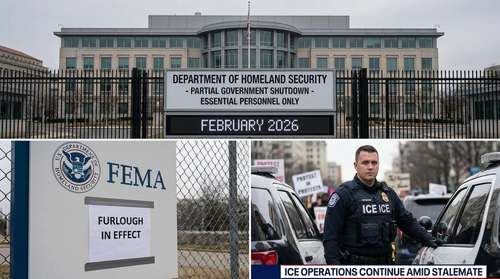
Washington — The Department of Homeland Security officially entered a partial government shutdown at midnight on Saturday, February 14, 2026, plunging Washington into a high-stakes political crisis. The funding lapse follows a collapse in Senate negotiations over Democratic demands for strict "guardrails" on immigration enforcement, triggered by the fatal shootings of two U.S. citizens in Minneapolis last month. As Capitol Hill empties for the Presidents' Day recess, thousands of federal employees face furloughs or unpaid work, marking the second funding gap of the year and casting a long shadow over the upcoming 2026 Midterm election news cycle.
Stalemate on the Hill: The Fight Over Judicial Warrants
The deadlock centers on a fundamental disagreement regarding the operational limits of Immigration and Customs Enforcement (ICE). Senate Democrats, led by Chuck Schumer and supported by House Minority Leader Hakeem Jeffries, blocked the DHS funding measure late Thursday. Their refusal stems from the Trump administration's rejection of legislative language requiring judicial warrants for ICE entries into private property—a direct response to the aggressive tactics seen in recent enforcement sweeps.
"We will not sign a blank check for unconstitutional chaos," Jeffries told reporters outside the Capitol on Friday. "Until there are statutory guarantees—masks off, body cameras on, and warrants in hand—DHS funding cannot proceed as business as usual." Republicans have countered that these demands would effectively neuter federal law enforcement capabilities. The White House accused the opposition of endangering national security, with officials stating that the administration "will not negotiate on the safety of the American people."
The Minneapolis Trigger: Fatalities and False Testimony
The political firestorm was ignited by events in Minnesota in January, where the ICE Minneapolis shooting investigation has rapidly evolved from a local tragedy to a national scandal. The deaths of Renee Good and Alex Pretti, both U.S. citizens killed during chaotic immigration raids, galvanized public outrage. Tensions escalated further this week when federal prosecutors dropped charges against a third target, Venezuelan national Julio Cesar Sosa-Celis, after video evidence contradicted sworn testimony by ICE agents.
Department of Homeland Security partial shutdown discussions were complicated by revelations that agents may have perjured themselves regarding the circumstances of the shootings. The footage reportedly showed agents entering a home without a warrant and engaging in unprovoked force, directly challenging the official narrative of self-defense. This crumbling credibility provided Democrats with the political leverage to demand the "Minneapolis Guardrails"—a package of reforms the Trump administration has thus far refused to entertain.
Investigation Deepens
Federal authorities have now opened a perjury probe into the officers involved. The swift unraveling of the official account has placed the Trump administration immigration crackdown under intense scrutiny, with critics arguing that the "Operation Metro Surge" prioritized speed and volume over constitutional rights and officer discipline.
An Uneven Shutdown: FEMA Furloughed, ICE Fully Funded
This shutdown presents a unique and contentious anomaly: the agencies at the center of the dispute are largely immune to its financial consequences. Thanks to the "One Big Beautiful Bill Act" passed last summer, ICE and Customs and Border Protection (CBP) possess multi-year appropriations that allow them to continue operations at full capacity. The financial pain will instead fall disproportionately on other DHS components that rely on annual appropriations.
FEMA furloughs February 2026 are expected to hit immediately, sending thousands of emergency management personnel home just as the agency attempts to reimburse states for recent winter disaster costs. "It is a cruel irony that the disaster responders are sent home while the enforcement agents—whose conduct caused this shutdown—continue to work with full pay," noted Senator Chris Murphy on the Senate floor. Meanwhile, Transportation Security Administration (TSA) agents are deemed essential and must report to airport checkpoints without pay, raising fears of sick-outs and travel delays similar to the 2019 shutdown.
Midterm Implications and What Comes Next
As the DHS government shutdown 2026 begins, both parties are positioning themselves for the November midterms. Republicans are betting that voters will blame Democrats for "defunding" homeland security, framing the standoff as obstructionism that weakens the border. Conversely, Democrats are gambling that the public demand for police accountability, fueled by the visceral footage from Minneapolis, will outweigh the inconvenience of a partial agency closure.
With the Senate not scheduled to return until February 23, the shutdown is all but guaranteed to last at least a week. The extended timeline increases the pressure on House Speaker Mike Johnson to broker a compromise, but with the Trump administration digging in on its refusal to accept warrant requirements, a quick resolution remains elusive.