The legal battle over United States trade policy has ignited once again. In a swift response to the Trump administration's latest global trade maneuver, a coalition of American retailers has launched a major Trump tariffs lawsuit. Filed just hours after the sweeping new levies took effect on July 24, 2026, the small business tariff challenge argues that the executive branch has overstepped its authority by imposing double-digit taxes on imports from over 60 countries. At the heart of the dispute is whether the government can use the pretext of 'forced labor' to implement near-universal tariffs without congressional approval.
The Core of the Liberty Justice Center Lawsuit
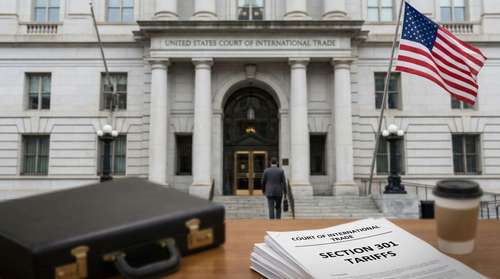
The prominent legal case, officially docketed as Burlap and Barrel v. Greer, was filed in the Court of International Trade by the Liberty Justice Center. The plaintiffs—New York-based spice importer Burlap & Barrel and California-based watch retailer Collective Horology—argue that the newly enacted Section 301 tariffs 2026 are unlawfully broad.
The Trump administration's latest trade directive imposes 10% to 12.5% duties on 99% of U.S. imports originating from numerous trade partners. The stated justification for these levies is the failure of these foreign governments to adequately prohibit or enforce bans on goods produced using forced labor. While the administration asserts these forced labor import duties are essential to leveling the playing field for American companies, critics claim it is a thinly veiled attempt to resurrect a universal tariff regime.
'Forced labor is morally indefensible, but an important objective does not give the government permission to ignore the law,' stated Sara Albrecht, chairman and CEO of the Liberty Justice Center. 'The administration allowed one global tariff to expire and immediately replaced it with another under a different statute. Changing the statute doesn't change the law'.
Shifting Justifications: From IEEPA to Section 301
To understand the magnitude of this Court of International Trade tariffs battle, it is essential to trace the recent history of the administration's trade policy. Earlier in 2026, the U.S. Supreme Court delivered a landmark 6-3 ruling that struck down the president's so-called 'Liberation Day' tariffs, which had been imposed under the International Emergency Economic Powers Act (IEEPA). The Court ruled that those near-global tariffs exceeded executive authority. Following that defeat, the administration briefly utilized Section 122 of the Trade Act of 1974, claiming a balance-of-payments deficit, but those temporary 10% tariffs expired late last week.
Now, the administration is relying on Section 301 of the Trade Act of 1974. Historically, Section 301 has been utilized to target specific unfair trade practices of individual nations—most notably against China during Trump's first term. However, trade experts note that applying Section 301 to simultaneously penalize 60 distinct economies with uniform rates is an unprecedented expansion of the statute.
How the Small Business Tariff Challenge Impacts Retailers
For independent retailers, the immediate financial strain of these forced labor import duties is severe. Unlike massive multinational corporations that can easily restructure their supply chains or absorb temporary tax hikes, small enterprises operate on thinner margins and rely on specialized, single-origin sourcing.
Burlap & Barrel, one of the lead plaintiffs, partners directly with smallholder farms in over 20 countries—including places like Vietnam, India, Spain, and Turkey—to source unique spices that cannot simply be grown domestically. 'These tariffs would punish a responsible American business, and the farmers we work with, without showing how taxes on our spices would address the policies of foreign governments that USTR says it is targeting,' noted co-founder Ethan Frisch.
Similarly, Collective Horology relies on international independent watchmakers from countries like France, Austria, and the United Kingdom. The Liberty Justice Center lawsuit emphasizes that these small businesses, and by extension American consumers, are unfairly bearing the financial burden of an executive policy that penalizes responsible supply chains without a targeted approach.
The Legal Battle Ahead in the Court of International Trade
The central legal question in Burlap and Barrel v. Greer is whether the Office of the United States Trade Representative (USTR) fulfilled its statutory obligations before levying the taxes. The Section 301 tariffs 2026 require the government to establish a specific chain of evidence: it must identify a particular foreign practice, demonstrate exactly how that practice burdens U.S. commerce, and explain why the chosen tariff is the appropriate remedy.
Lawyers for the plaintiffs argue that the USTR failed to conduct the 'country-specific inquiry' that Congress mandated. Instead of investigating the distinct labor enforcement laws of each targeted nation, the administration allegedly painted the entire global supply chain with a broad brush. By seeking class-action status for all affected importers of record, the lawsuit aims not only to strike down the tariffs but to secure refunds—with interest—for all duties paid under the new directive.
What This Means for Global Commerce
If the court determines that the administration overstepped its bounds yet again, it could severely limit the president's ability to unilaterally rewrite international trade rules. Conversely, if the forced labor import duties are upheld, it will signal a massive expansion of executive power under Section 301, potentially normalizing double-digit global tariffs as a standard tool of American economic policy.
For now, companies across the United States are left navigating a chaotic regulatory environment. While the small business tariff challenge moves rapidly through the judicial system, importers must continue paying the contentious levies, hoping that the courts will once again check the boundaries of presidential authority in international trade.