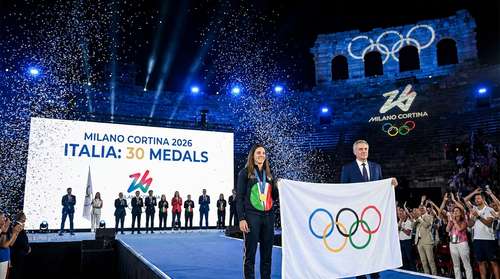
The 2026 Winter Olympics officially ended yesterday with a spectacular "Beauty in Action" ceremony at the ancient Arena di Verona, marking the conclusion of the most spread-out Games in history. Under the open sky of the Roman amphitheater, the Olympic flag was formally handed over to representatives from France for the 2030 Winter Games, while host nation Italy celebrated a historic achievement. The local crowds roared as the final tally confirmed Italy's record medal count of 30 podium finishes, cementing Milano Cortina 2026 as a landmark event for Italian winter sports.
A Historic Finale at Arena di Verona
For the first time in Olympic history, the closing ceremony was held in a World Heritage site of such antiquity. The Arena di Verona, a first-century Roman amphitheater, provided an intimate and breathtaking backdrop for the farewell to the XXV Winter Games. Unlike the high-tech spectacle of the opening at San Siro, yesterday's event focused on Italian cultural heritage, opera, and the theme "Beauty in Action."
The ceremony eschewed traditional fireworks for a sophisticated light show to protect the historic structure, illuminating the stone arches in the colours of the Italian flag. Highlights included a mesmerizing performance by world-renowned ballet star Roberto Bolle and a high-energy set by singer Achille Lauro, which brought athletes to their feet. In a poignant moment symbolizing the dual-city hosting model, the Olympic cauldrons in both Milan and Cortina d'Ampezzo were extinguished simultaneously via video link, officially bringing the Milano Cortina closing ceremony highlights to an emotional end.
Italy's Record-Breaking Medal Haul
The host nation gave its fans plenty of reasons to celebrate. Italy concluded the Games with a total of 30 medals—10 gold, 6 silver, and 14 bronze—shattering its previous Winter Olympic records. This performance secured Italy a prestigious fourth place on the overall medal table, finishing ahead of traditional powerhouses like Germany and France.
Italian athletes delivered in crucial moments across diverse disciplines. From the slopes of Cortina to the ice rinks of Milan, the "Azurri" capitalized on the home-field advantage. The Italy record medals 2026 achievement was bolstered by standout performances in alpine skiing and short-track speed skating, proving that the country's investment in winter sports has paid immense dividends.
Norway and USA Top the Final Standings
While Italy celebrated its personal best, Norway once again asserted its dominance as the world's winter sports superpower. The Scandinavian nation topped the 2026 Winter Olympics final medal count with a staggering 41 medals, including a record-breaking 18 golds. Cross-country skiing sensation Johannes Høsflot Klæbo was the undisputed star, capturing six gold medals and etching his name into Olympic legend.
Team USA also left Italy with a historic haul, finishing second overall with 33 medals (12 gold). The American team found success across the board, from figure skating to the sliding track, marking one of their most successful Winter Games performances in recent history.
Passing the Torch: Olympic Flag Handover 2030
As the evening drew to a close, the focus shifted to the future. In the traditional handover ceremony, the mayors of Milan and Cortina passed the Olympic flag to IOC President Kirsty Coventry, who then presented it to Renaud Muselier and Fabrice Pannekoucke, representing the French Alps 2030 host region. This symbolic moment marked the official transition to the next Winter Games.
A "New Dawn" for the French Alps
The French delegation wasted no time making an impression. Their artistic segment, titled "A New Dawn," featured a spine-tingling, reimagined rendition of "La Marseillaise" performed by mezzo-soprano Marine Chagnon. Visuals of light rising over the Mont Blanc massif filled the arena, promising a return to the heart of the European mountains for the Olympic flag handover 2030.
With the flame extinguished and the athletes departing, Milano Cortina 2026 leaves behind a legacy of decentralized sustainable hosting and a revitalized Italian winter sports program. The baton now rests with the French Alps, but the echoes of Verona's historic night will resonate for years to come.