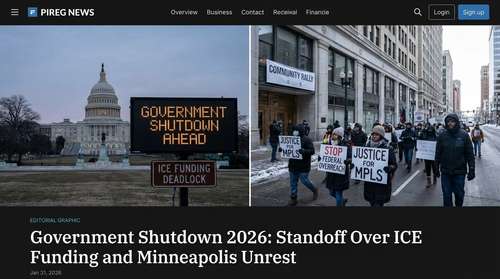
The United States federal government officially entered a partial government shutdown 2026 at midnight Saturday, plunging Washington into legislative paralysis following a chaotic week of protests and political brinkmanship. While the Senate managed to pass a last-minute funding package late Friday night, the measure came too late to prevent a lapse in appropriations, as the House of Representatives had already departed the capital until Monday.
At the heart of the deadlock is a ferocious battle over the ICE funding budget bill, which has become the central flashpoint of the 2026 fiscal fight. Democratic lawmakers, galvanized by massive Minneapolis federal agent protests, refused to authorize standard funding for the Department of Homeland Security (DHS) without sweeping reforms. The legislative stalemate follows a month of escalating tensions in the Twin Cities, where the controversial "Operation Metro Surge" resulted in the deaths of two U.S. citizens at the hands of federal agents.
Senate Scrambles as House Absence Seals Shutdown
In a dramatic late-night session on January 30, the Senate voted to approve a complex funding package intended to avert a prolonged crisis. The deal, brokered between Senate leadership and the White House, would fund most federal agencies through September while isolating the toxic issue of immigration enforcement. Under the plan, DHS funding was stripped from the main package and given only a two-week stopgap extension to allow for further negotiations.
However, with the House of Representatives out of session until Monday evening, the partial government shutdown Jan 31 became inevitable the moment the clock struck 12:00 a.m. While Senate leaders have expressed hope that the shutdown will be technically brief—potentially resolving early next week—the political chasm suggests otherwise. House Minority Leader Hakeem Jeffries has declined to guarantee Democratic support for the Senate's compromise, citing the need for "ironclad" reforms to Immigration and Customs Enforcement (ICE) practices.
The Spark: Minneapolis Killings Ignite National Outrage
The budget battle cannot be understood without looking at the streets of Minneapolis, where Trump immigration crackdown news has shifted from policy debates to tragedy. The current crisis erupted following the launch of "Operation Metro Surge," a high-visibility enforcement campaign championed by DHS Secretary Kristi Noem.
Tensions exploded earlier this month after the death of Renee Good, a U.S. citizen killed by an ICE agent on January 7. But the situation reached a boiling point on January 24 with the killing of Alex Pretti, a 37-year-old ICU nurse and VA employee. According to witness video and reports, Pretti was filming federal agents during a protest when he was pepper-sprayed, tackled, and shot multiple times by Customs and Border Protection (CBP) agents.
The Death of Alex Pretti
The details of Pretti's death have horrified the nation and stiffened congressional resolve. Footage appears to show Pretti, a registered gun owner with a valid permit, being pinned to the ground by multiple agents before shots were fired. While the Trump administration initially labeled Pretti an "agitator," the revelation that he was a federal healthcare worker intervening to protect a fellow protester has fueled the Minneapolis federal agent protests that have since spread to New York, Los Angeles, and Chicago.
Political Fallout: Senate vs House Funding Deadlock
The Senate vs House funding deadlock is now effectively a proxy war over the future of federal immigration enforcement. Senate Democrats, under pressure from their base, blocked the original DHS spending bill, demanding requirements for body cameras and bans on the type of roving patrols used in Minneapolis.
President Trump, currently in the second year of his second term, has dug in his heels. In statements issued from the White House, he defended the agents involved and blasted the threatened funding cuts as a betrayal of law enforcement. His administration points to the "One Big Beautiful Bill Act" of 2025, which allocated $75 billion to ICE, as the law of the land, though Democrats are now attempting to repeal portions of that funding through the appropriations process.
What This Crisis Means for Americans
As the US political crisis 2026 deepens, the immediate impact falls on federal workers and travelers. Beginning Saturday morning, over 50,000 TSA screeners and 14,000 air traffic controllers are required to work without pay. Unions representing these workers have warned that if the shutdown extends beyond the weekend, "sick-outs" could cause significant disruptions at major airports.
Meanwhile, the "ICE Out" coalition has announced plans for a nationwide strike and day of action, urging citizens to stay home from work and school to protest the government's immigration tactics. With the House not scheduled to return until Monday, the weekend will serve as a tense waiting period, with the eyes of the nation fixed on a government that is currently closed for business.