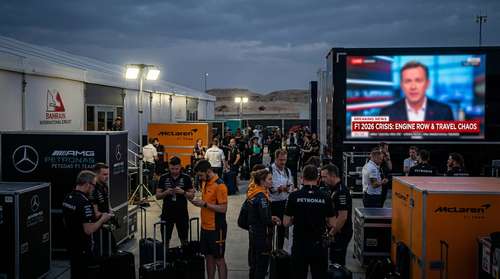
MELBOURNE, Australia — The dawn of Formula 1’s revolutionary 2026 era faces a chaotic false start. Just days before the engines fire up at Albert Park for the season-opening Australian Grand Prix, a logistical nightmare has left over 100 key personnel from Mercedes, McLaren, and Pirelli stranded in Bahrain.
The crisis, triggered by escalating regional conflict in the Middle East, forced the sudden cancellation of a post-season Pirelli tire test at Sakhir. With commercial flights grounded and airspace restrictions tightening, critical mechanics, engineers, and strategists are currently unable to travel to Melbourne. The timing could not be worse: the first practice session for the 2026 Australian Grand Prix is scheduled for this Friday, March 6, and teams are racing against the clock to get their crews on the ground.
Bahrain 'No-Fly' Zone Threatens Season Opener
Sources confirm that charter planes carrying essential staff from the Mercedes-AMG PETRONAS and McLaren Formula 1 teams have been denied takeoff clearance from Manama due to security concerns. The stranded group includes high-level performance engineers and the specialized mechanics responsible for assembling the complex new 2026 power units.
"We are working with the FIA and local authorities to secure a safe corridor for our people," a Mercedes spokesperson stated early Monday morning. "Our priority is their safety, but from a sporting perspective, this is a race against time. The cars are in Melbourne, but the people who know how to run them are stuck 7,000 miles away."
McLaren Team Principal Andrea Stella, whose team enters the season as defending Constructors' Champions following their 2024 and 2025 triumphs, expressed deep concern. With Lando Norris set to defend his Drivers' title, the team cannot afford a compromised start. If the staff cannot depart within the next 24 hours, both Mercedes-powered giants may be forced to rely on skeleton crews and factory-based support for Friday's critical setup sessions.
FIA Emergency Ruling: The Engine Compression Controversy
As if the logistical turmoil wasn't enough, a technical firestorm has erupted in the paddock. The FIA has issued a last-minute emergency ruling regarding the 2026 power unit regulations, specifically targeting a loophole involving engine compression ratios.
Rival teams, led by Red Bull and Ferrari, have accused Mercedes of "sandbagging"—hiding their true performance during February's testing. They allege that the German manufacturer found a way to legally bypass the 16:1 compression ratio limit by designing components that expand under heat. While the engine passes the static "cold" checks, it reportedly exceeds the ratio at race temperatures (130°C), unlocking significant horsepower.
In a controversial compromise announced late Sunday, the FIA confirmed that while the loophole violates the spirit of the rules, the new, stricter "hot testing" procedures will not be enforced until June 1, 2026. This effectively gives Mercedes and its customers—McLaren, Williams, and Alpine—a legal performance advantage for the first seven rounds of the championship.
Red Bull and Ferrari Fury
The decision has sparked fury among competitors. Red Bull Team Principal Laurent Mekies reportedly petitioned for an immediate ban, arguing that the loophole makes a mockery of the sustainable fuel efficiency goals of the new regulations. With the Mercedes power unit rumored to have a distinct edge in electrical deployment and thermal efficiency, the delay in closing the loophole could decide the early momentum of the title fight.
A New Era on a Knife-Edge
The 2026 season was marketed as a fresh start for the sport, featuring nimble cars, 100% sustainable fuels, and a 50/50 split between electric and combustion power. However, the narrative has quickly shifted from innovation to crisis management.
Australian Grand Prix organizers remain confident the event will proceed, but the paddock atmosphere is tense. The debut of rookie sensation Kimi Antonelli at Mercedes and the arrival of Adrian Newey at Aston Martin are currently overshadowed by the uncertainty of whether the cars will have full crews to service them.
For now, the F1 world watches Bahrain. If the airspace does not clear by Tuesday, the 2026 season opener may see two of its biggest contenders fighting with one hand tied behind their backs—not on the track, but in the logistics war room.