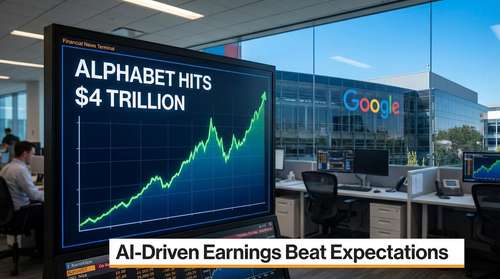
In a historic market shift that underscores the dominance of artificial intelligence in the global economy, Alphabet Inc. (GOOGL) has officially surpassed a $4 trillion market capitalization. The tech behemoth shattered Wall Street expectations in its Q4 2025 earnings report released Wednesday, driven by a staggering 48% surge in Google Cloud revenue and the rapid adoption of its Gemini 3 AI model. As of Thursday morning, the Alphabet stock price reflects a company operating at the peak of its powers, silencing skeptics who once feared it had fallen behind in the AI arms race.
The $4 Trillion Milestone: A New Era for Alphabet
Alphabet has now become only the fourth company in history to breach the $4 trillion valuation mark, joining the ranks of Nvidia, Apple, and Microsoft. The surge comes on the heels of a blockbuster fourth quarter where the company reported consolidated revenue of $113.8 billion, an 18% increase year-over-year that comfortably beat analyst projections of $111.3 billion. Earnings per share (EPS) landed at $2.82, outpacing the consensus estimate of $2.63.
The market's reaction was initially volatile, with shares dipping in after-hours trading due to sticker shock over future spending, before rallying as investors digested the sheer scale of Google's growth engines. The company’s ability to monetize AI is no longer theoretical; it is showing up on the balance sheet with undeniable force. "Search saw more usage than ever before, with AI continuing to drive an expansionary moment," CEO Sundar Pichai told investors, confirming that the integration of generative AI into Search has revitalized the core business rather than cannibalized it.
Cloud and AI: The Engines of Growth
While the advertising business remains a cash cow, the real star of the Alphabet earnings report 2026 was Google Cloud. The division posted revenue of $17.7 billion, up 48% from the previous year. This growth rate significantly outpaced rivals and signaled that enterprise customers are flocking to Google's infrastructure to train and deploy their AI models.
Operating margins for the Cloud unit also expanded to nearly 30.1%, proving that the business is not just growing—it is becoming immensely profitable. This performance validates the company's years of heavy investment in tensor processing units (TPUs) and custom silicon, which are now powering everything from startup unicorns to Fortune 500 AI strategies.
Gemini AI Search Impact and User Explosion
Central to this success is the Gemini AI search impact. Sundar Pichai revealed a stunning metric during the earnings call: the Gemini app has crossed 750 million monthly active users (MAUs). The launch of the Gemini 3 model in December 2025 appears to have been an inflection point, driving higher engagement and unlocking new subscription revenue streams. With over 8 million paid seats for Gemini Enterprise, Google is successfully translating consumer buzz into corporate recurring revenue.
The Cost of Ambition: Massive 2026 Capex Outlook
If there was one blemish in the report that gave traders pause, it was the company's capital expenditure guidance. Alphabet announced it plans to spend between $175 billion and $185 billion in 2026—a figure that nearly doubles its 2025 spend. This astronomical sum is earmarked for building out the data centers and energy infrastructure required to support next-generation AI models.
Some analysts expressed concern over this "spending war" with Nvidia and Microsoft, fearing it could compress margins in the short term. However, CFO Anat Ashkenazi defended the strategy, framing it as a necessary moat. "We are seeing our AI investments and infrastructure drive revenue and growth across the board," she noted. For long-term investors, the message is clear: Alphabet is playing to win the decade, not just the quarter.
AI Stock Trends 2026: What’s Next for Google?
As we move further into 2026, the AI stock trends are shifting from pure speculation to execution. Alphabet's ability to maintain double-digit growth at a $4 trillion scale is unprecedented. The company is effectively fighting a multi-front war—defending Search against Perplexity and OpenAI, while aggressively taking Cloud market share from Amazon and Microsoft.
For investors eyeing the Alphabet stock price, the key metric to watch in the coming quarters will be the "return on invested capital" (ROIC) for these massive AI expenditures. If Google Cloud continues to grow at near 50%, the $185 billion price tag for infrastructure will look like a bargain. But if growth slows, that valuation could face scrutiny. For now, however, the market has spoken: Google is an AI superpower, and it has the $4 trillion badge to prove it.