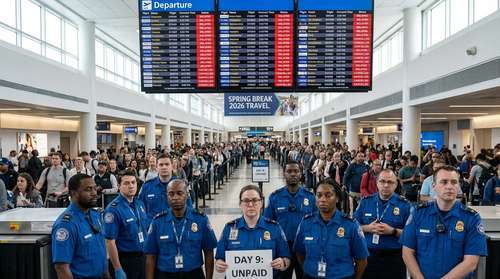
WASHINGTON D.C. – The travel nightmare at America's airports is intensifying as the partial government shutdown enters its ninth day this Sunday. With no resolution in sight for the funding dispute crippling the Department of Homeland Security (DHS), over 61,000 Transportation Security Administration (TSA) agents are now working their second week without pay. The staffing crisis comes at a perilous moment, with the massive Spring Break 2026 travel rush set to begin in less than two weeks, raising alarms of a potential aviation meltdown.
Unpaid Agents and Rising "Blue Flu" Absences
As of February 22, 2026, the morale among the nation’s frontline security workforce has hit rock bottom. TSA officers, deemed "essential" government employees, are required to report for duty despite their paychecks being frozen since the shutdown began on Valentine’s Day. The financial strain is already translating into operational friction, with union officials warning that absenteeism—often referred to as the "Blue Flu"—is beginning to spike at major hubs.
"Our officers are patriots, but they are also people with mortgages, childcare costs, and gas bills," said a representative from the American Federation of Government Employees (AFGE), which represents a majority of the TSA workforce. "Asking them to secure the nation's skies while their bank accounts run dry is unsustainable. We are already seeing call-outs increase at high-cost-of-living airports like JFK and San Francisco, simply because officers cannot afford the commute."
Security Checkpoint Delays Widen
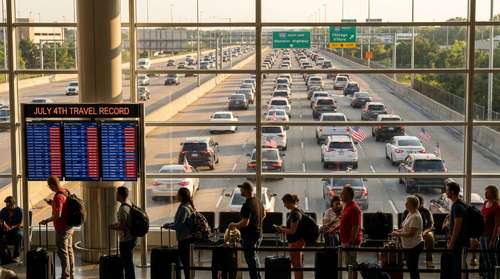
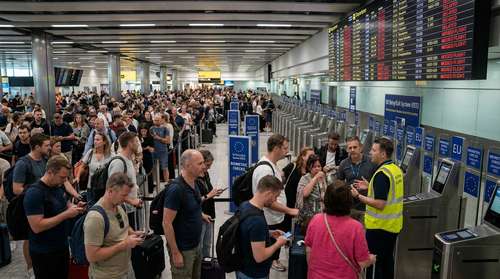
Travelers are beginning to feel the impact. While TSA has maintained that security standards remain uncompromised, wait times at checkpoints have crept upward over the weekend. Reports from Hartsfield-Jackson Atlanta International Airport and Miami International Airport indicate security lines stretching over 45 minutes during peak morning hours—nearly double the standard wait time. With staffing levels precarious, airport administrators fear that even a small uptick in officer absences could trigger cascading delays reminiscent of the 2019 shutdown.
Spring Break 2026: A Looming Travel Disaster
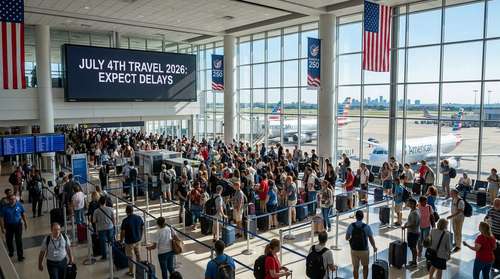
The timing of this political standoff could not be worse for the U.S. travel industry. The spring break travel season, traditionally one of the busiest periods of the year, is scheduled to kick off in earnest around March 6. Industry analysts project that over 140 million passengers will pass through U.S. airports between March and April, a 4% increase from 2025.
Travel trade groups are sounding the alarm, urging Congress to pass a clean funding bill immediately. "If this shutdown drags into March, we aren't just looking at long lines; we are looking at missed flights, stranded students, and a potential economic loss of billions," warned the U.S. Travel Association in a press statement Saturday. The concern is that if TSA lanes are consolidated due to staffing shortages, the system will lack the throughput capacity to handle the spring surge, turning terminals into bottlenecks.
The DHS Funding Deadlock
The current crisis stems from a legislative impasse over the Department of Homeland Security's fiscal year budget. While other government sectors remain funded, the expiration of DHS appropriations on February 14 triggered the partial shutdown. Contentious debates over border security allocations and administrative policies have stalled progress on Capitol Hill, leaving the TSA, Coast Guard, and Border Patrol in financial limbo.
DHS Secretary Kristi Noem has reiterated that safety remains the priority, but the department's ability to maintain seamless operations is degrading by the day. "We are asking our workforce to do the impossible," a DHS spokesperson admitted off-the-record. "Every day this continues, the risk to the system grows."
What Travelers Need to Know
For those with flights booked in the coming days, experts advise taking extra precautions to navigate the uncertainty:
- Arrive Earlier: The standard "two hours before domestic flights" rule should be extended to three hours, especially at major international hubs.
- Monitor TSA App: Use the MyTSA app to check real-time wait estimates, though be aware that conditions can change rapidly if a shift sees high call-outs.
- Pack Patience: Frontline agents are working under immense stress without pay; confrontations at checkpoints only slow down the process further for everyone.
As the clock ticks toward the critical spring travel window, the pressure is mounting on Washington to break the deadlock. For now, however, millions of travelers and tens of thousands of unpaid federal workers remain caught in the middle of a deepening crisis.