President Donald Trump issued a severe ultimatum on Sunday, warning that the United States is prepared to "start dropping bombs again" unless an immediate resolution is reached in the Persian Gulf. The stark declaration comes as Tehran reversed course this weekend, abruptly reimposing its restriction on commercial shipping through a vital global choke point. This escalating Trump Iran military threat underscores a rapidly deteriorating situation, with the Strait of Hormuz blockade 2026 triggering renewed fears of catastrophic economic fallout. As the maritime standoff intensifies, the US Navy Fifth Fleet has been placed on high alert, halting major trade routes and throwing global energy markets into deep uncertainty.
Ceasefire Deadline Approaches Amid Escalation
A temporary two-week truce between Washington and Tehran is slated to expire this Wednesday, leaving the international community bracing for a devastating escalation. Speaking to reporters aboard Air Force One, the commander-in-chief offered a bleak assessment of the stalled diplomatic efforts. When asked about extending the ceasefire, he bluntly stated: "Maybe I won't extend it, but the blockade is going to remain... and unfortunately we have to start dropping bombs again".
This unprecedented brinkmanship represents a defining moment for President Trump foreign policy. The U.S. military has maintained a strict naval blockade on all vessels entering or leaving Iranian ports since the failure of the Islamabad peace talks in mid-April. While Tehran briefly announced it would allow passage through the strait during a parallel truce in Lebanon, the Iranian joint military command abruptly revoked that access on Saturday.
Iran's Khatam al-Anbiya Central Command cited the ongoing American blockade of its ports as "piracy," warning that control of the waterway has reverted to its previous, highly restricted state. A senior Iranian parliamentary spokesman brushed off the Trump Iran military threat as a "bluff," though regional military posture suggests otherwise.
Commercial Shipping Under Fire in the Gulf
For anyone following the latest US Iran war news, the reality on the water has shifted from diplomatic posturing to active kinetic engagement. Commercial vessels attempting to transit the corridor over the past 48 hours have faced direct aggression, turning a diplomatic standoff into a live-fire zone.
IRGC Gunboats Target Vessels
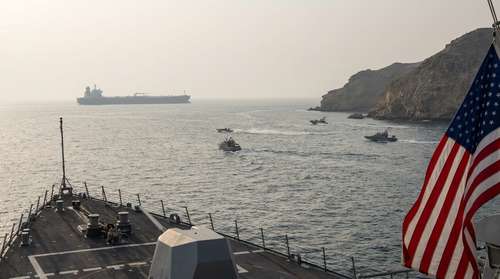
Security monitors reported multiple alarming incidents over the weekend. The India-flagged tanker Sanmar Herald was approached by two Islamic Revolutionary Guard Corps (IRGC) patrol boats that fired shots without prior radio contact, causing significant damage to the ship's bridge windows. Meanwhile, the Malta-flagged cruise ship Mein Schiff 4 reported a near-miss projectile splash off the coast of Oman after receiving chilling radio traffic from IRGC units threatening to "fire and destroy" them.
The US Navy Fifth Fleet, responsible for American naval forces in the Persian Gulf, Red Sea, and Arabian Sea, remains heavily engaged in monitoring the situation. U.S. Central Command confirmed it has already turned around dozens of ships as it actively enforces the U.S. side of the Strait of Hormuz blockade 2026 against Iran-linked shipping. Forward-deployed units are actively conducting visit, board, search, and seizure operations to ensure the embargo holds, increasing the likelihood of a direct naval clash.
Fears of a Catastrophic Global Oil Supply Disruption
At the heart of the Middle East crisis today is the sheer volume of global energy that relies on the safe passage of the Strait of Hormuz. Before the conflict erupted earlier this year, roughly one-fifth of the world's daily oil and liquefied natural gas consumption passed through this narrow waterway.
A prolonged global oil supply disruption is the nightmare scenario for international markets. Following a brief dip in prices on Friday when reopening hopes peaked, Brent crude has seen extreme volatility as the realization of a sustained closure sets in. If the Wednesday ceasefire deadline passes without an agreement, energy experts warn that a resumption of hostilities could severely constrain supplies.
Such a global oil supply disruption would heavily inflate consumer prices at the pump globally, with some analysts projecting barrels could soon spike past $110. The economic ripple effects of the Strait of Hormuz blockade 2026 will touch everything from domestic manufacturing to global logistics.
What Comes Next For US-Iran Relations?
The window for a diplomatic breakthrough is rapidly closing. The failure of recent talks highlighted the immense gap between the two sides. Washington is demanding sweeping concessions, including strict parameters on Iran's nuclear program, while Tehran insists that the strait will remain shut until the U.S. completely lifts its naval embargo.
For observers analyzing President Trump foreign policy, the coming days will be heavily scrutinized. The administration must weigh the economic costs of a prolonged standoff against the strategic goal of securing a comprehensive deal.
With neither side willing to blink, the immediate future hinges on Wednesday's deadline. Whether the Trump Iran military threat translates to renewed airstrikes or whether back-channel negotiations can produce an eleventh-hour miracle remains to be seen. As the Middle East crisis today reaches its boiling point, the world watches anxiously for the next wave of US Iran war news, hoping a last-minute deal can avert a devastating return to full-scale war.