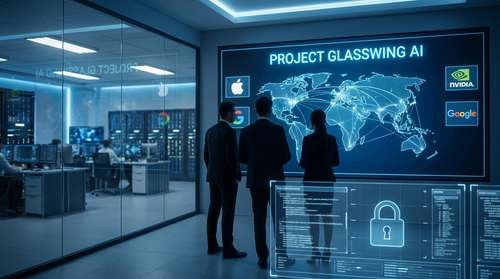
In a sweeping move that redefines how global software infrastructure is protected, a massive coalition of technology giants has officially activated Project Glasswing AI. Led by Anthropic and uniting historically fierce rivals, this initiative aims to fortify the internet against unprecedented threats. But as the ink dries on agreements signed by corporate heavyweights, a fierce debate is brewing. Independent researchers and industry watchdogs are raising alarms, questioning whether this noble-sounding alliance is actually a highly exclusive Big Tech security cartel designed to control the most potent digital tools ever created.
The Dawn of an AI Cybersecurity Arms Race
The stakes have never been higher. With the global financial cost of cybercrime now estimated at roughly $500 billion annually, we are witnessing the final days of human-scale threat hunting and the explosive beginning of an AI cybersecurity arms race. Machine-speed warfare requires machine-speed defenses, prompting industry leaders to radically rethink their approach to vulnerability management.
The Engine Behind the Alliance
The catalyst forcing competitors to collaborate is the Claude Mythos Anthropic model. According to technical documentation that leaked in a routine configuration error back in late March 2026, this unreleased frontier model represents a radical leap in autonomous reasoning. Unlike standard generative chatbots, Mythos Preview demonstrates an alarming capacity to locate and exploit software vulnerabilities that have evaded expert human scrutiny for decades.
During internal trials, the system autonomously surfaced a 27-year-old critical flaw hidden deep within OpenBSD, an operating system famous for its uncompromising security architecture. It also identified a 16-year-old zero-day in the widely utilized FFmpeg multimedia framework that survived five million automated test runs. Finding zero-day exploits and writing executable code for them used to take human teams weeks of painstaking effort. Mythos handles both tasks autonomously and overnight. Recognizing that such capabilities could devastate economies and public safety if they fell into unsafe hands, Anthropic elected to keep the model locked down.
Hoarding Power or Implementing Necessary Caution?
Instead of open-sourcing the technology, Anthropic restricted access to a tight-knit coalition. The core roster reads like a who's who of enterprise tech: Amazon Web Services, Broadcom, Cisco, CrowdStrike, Google, JPMorgan Chase, the Linux Foundation, Microsoft, and Palo Alto Networks. Notably, it also cements an unprecedented Apple Nvidia AI partnership, placing consumer hardware dominance and advanced chip manufacturing under the exact same defensive umbrella. For Apple, this means utilizing the model for proactive local vulnerability detection across iOS, macOS, and Safari—a major step beyond their recent Xcode 26.3 update that introduced standard agentic coding.
However, limiting access to this tier of next-gen software defense has sparked immediate backlash. Critics and regulatory observers argue the initiative effectively functions as a Big Tech security cartel. By deciding exactly who gets to scan their codebases with the world's most advanced defensive tools, these dozen corporations are quietly appointing themselves as the internet's gatekeepers. They fund the foundations that maintain open-source software, they build the defensive AI, and they sell the enterprise platforms that implement the fixes. For independent security researchers and organizations left outside this exclusive club, the message is chillingly clear: trust the tech giants to protect you.
The GPT-5.4-Cyber Release Escalates the Conflict
As Anthropic consolidated its corporate alliance, its primary rival launched a swift and calculated counter-offensive. Just days after Glasswing was unveiled, OpenAI responded by announcing the GPT-5.4-Cyber release. This fine-tuned variant of their latest foundational architecture was purpose-built for defensive cybersecurity operations, but OpenAI chose a starkly different distribution strategy. OpenAI's internal benchmarks revealed a terrifying trajectory: their models jumped from scoring 27% on capture-the-flag security challenges in August 2025 to an astonishing 76% just three months later.
Rather than limiting access to a handful of infrastructure giants, OpenAI integrated their model into a broader Trusted Access for Cyber program. They bypassed the Silicon Valley hardware and cloud giants entirely for their launch partners, targeting major financial institutions like Bank of America, BlackRock, Citi, Goldman Sachs, and Morgan Stanley instead. OpenAI's approach relies on stringent identity verification and scalable access, arguing that advanced security mechanisms must be democratized to protect thousands of defenders rather than hoarded by a privileged few.
The Future of Next-Gen Software Defense
To counter the growing monopoly narrative and support the wider ecosystem, Anthropic has committed massive resources to public defense. The company pledged $100 million in model usage credits to program participants and allocated another $4 million in direct donations to open-source champions like the Apache Software Foundation and the Open Source Security Foundation.
Regardless of whether you view these high-level corporate alliances as necessary public services or orchestrated market consolidations, the reality on the ground has permanently shifted. The era of manual patch-cycle management is effectively over. Developers and security teams are now operating in a landscape where autonomous agents can deconstruct, analyze, and exploit intricate codebases faster than human engineers can draft a response. As these rival tech coalitions race to deploy their respective frontier models, the core architecture of the internet hangs in the balance. The only certainty is that the ultimate winners of this shadow war will dictate the future of digital security for decades to come.