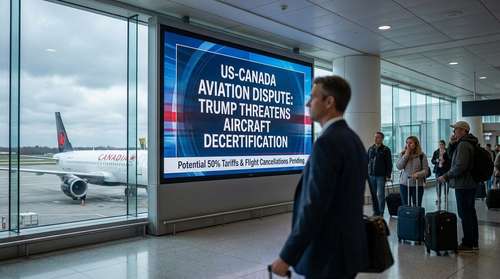
Washington, D.C. – A massive aviation crisis is looming over North American skies this weekend after President Donald Trump issued a stunning ultimatum to Canada. In a late-night post on Truth Social, the President threatened to immediately de-certify all Canadian-manufactured aircraft and impose a punitive 50% tariff unless Ottawa certifies American-made Gulfstream jets. The move, which experts are calling an unprecedented escalation in the aviation trade dispute 2026, has sent shockwaves through the airline industry and could lead to widespread grounding of flights as early as Monday.
The Ultimatum: Trump Targets Canadian Aircraft
The dispute erupted into the public eye on Thursday night when President Trump accused Canadian authorities of "wrongfully, illegally, and steadfastly" refusing to certify high-end business jets from Gulfstream Aerospace. Specifically, the President claims that Transport Canada is blocking the entry of Gulfstream G500, G600, G700, and G800 models to protect domestic competitor Bombardier.
"We are hereby decertifying their Bombardier Global Expresses, and all Aircraft made in Canada, until such time as Gulfstream, a Great American Company, is fully certified," Trump declared. He further warned that if the situation is not "immediately corrected," the U.S. will hit all Canadian aircraft sold into the United States with a crippling 50% tariff. This threat of Trump Canadian aircraft decertification effectively puts thousands of planes—from private business jets to commercial airliners like the Airbus A220—in regulatory limbo.
White House Clarification Sparks Confusion
While the President’s social media post suggested an immediate grounding of all Canadian-made planes currently in service, White House officials have since scrambled to clarify the scope of the order. Late Friday, administration sources signaled that the Canadian airplane tariffs and decertification might initially apply only to new aircraft rolling off the assembly line. However, the lack of a formal executive order has left airlines and private operators in a state of panic, unsure if their existing fleets will be legal to fly within U.S. airspace next week.
The Gulfstream Dispute: What’s Behind the Feud?
At the heart of this conflict is the Gulfstream jet certification process. The Savannah-based aerospace giant has been seeking Canadian approval for its latest ultra-long-range jets, which compete directly with Bombardier’s flagship Global Express series. Trump has framed the regulatory delays in Ottawa not as safety protocols, but as a protectionist trade barrier designed to shield Quebec-based Bombardier from American competition.
Canadian officials have pushed back, with Industry Minister Mélanie Joly stating that the certification process is "well underway" and follows standard safety reviews. Despite this, the President’s patience appears to have run out. "Canada is effectively prohibiting the sale of Gulfstream products," Trump asserted, positioning the potential aviation trade dispute 2026 as a necessary measure to defend American manufacturing jobs.
Potential for Mass Flight Cancellations
If the President follows through on his threat to de-certify existing aircraft, the impact on travelers would be catastrophic. Aviation analytics firm Cirium estimates there are over 5,000 Canadian-built aircraft currently operating in the United States. This includes popular regional jets like the CRJ series and the Airbus A220 (formerly the Bombardier CSeries), which are workhorses for major U.S. carriers like Delta and JetBlue.
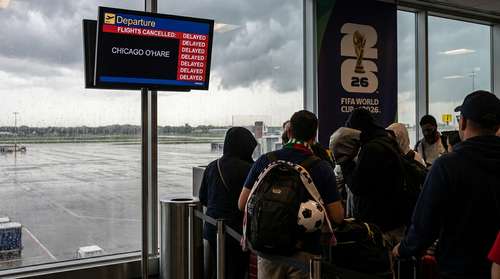
A grounding order would likely result in massive airline flight cancellations 2026, stranding tens of thousands of passengers. "If the FAA revokes airworthiness certificates for these planes, they simply cannot fly," explained aviation analyst Sarah Jenkins. "We aren't just talking about private jets for billionaires; we are talking about the regional routes that connect small-town America to major hubs. The disruption would be instantaneous."
Economic Fallout: Tariffs and Ticket Prices
Beyond the immediate operational chaos, the threatened 50% tariff would fundamentally alter the economics of the North American aerospace market. Airlines planning to refresh their fleets with fuel-efficient Canadian aircraft would face prohibitive costs, likely forcing them to cancel orders or pass the expenses onto consumers. The impact of tariffs on airfare could be significant, with analysts predicting ticket price hikes of 15-20% on routes heavily reliant on affected aircraft types.
Travelers are already being advised to check their flight status. several travel agencies have issued US Canada travel alerts, warning clients of potential disruptions to transborder flights. Bombardier, for its part, has stated it is "in contact" with the Canadian government and urged a quick resolution to avoid "significant impact to air traffic."
As the weekend progresses, all eyes are on the FAA and Transport Canada. With the deadline for "immediate correction" looming, the aviation industry is bracing for what could be the most disruptive trade war in modern history.