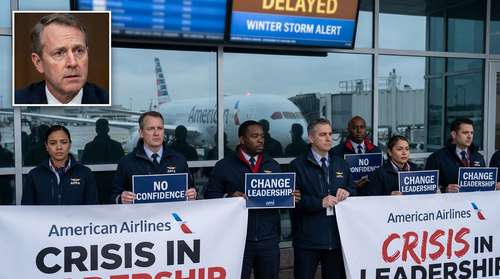
American Airlines is facing one of the most severe leadership challenges in its history after the Association of Professional Flight Attendants (APFA) issued a unanimous no confidence vote in CEO Robert Isom this week. The unprecedented move, announced on February 9, 2026, signals a breaking point for labor relations at the world's largest carrier, following a catastrophic operational performance during Winter Storm Fern and persisting financial lags behind key competitors.
Unions Unite: A Historic Rebuke of Leadership
The tension reached a fever pitch when the APFA, representing over 28,000 flight attendants, formally declared they had lost faith in Isom's ability to lead. This marks the first time in the union's history that such a vote has been cast against an American Airlines CEO. The declaration was swift and scathing, with union leadership citing a "relentless downward spiral" that has left employees demoralized and the airline competitively vulnerable.
"From abysmal profits earned to operational failures that have front-line workers sleeping on floors, this airline must course-correct before it falls even further behind," said APFA President Julie Hedrick in a blistering statement. "This level of failure begins at the very top."
The flight attendants are not standing alone. Just days earlier, on February 6, the Allied Pilots Association (APA), representing 16,000 pilots, sent a letter to the airline's board of directors expressing a similar loss of confidence. APA spokesperson Captain Dennis Tajer emphasized that the airline is on an "underperforming path" and has failed to define a clear identity to compete with rivals like Delta and United.
Operational Meltdowns: The Impact of Winter Storm Fern
The catalyst for this rebellion appears to be the carrier's disastrous handling of Winter Storm Fern in late January 2026. While severe weather impacted all U.S. carriers, American Airlines was disproportionately affected, canceling nearly 6,800 flights—approximately 43.4% of its schedule—during the critical period between Jan. 23 and Jan. 28.
For passengers and crew alike, the meltdown was a nightmare. Reports surfaced of flight attendants and pilots being stranded without hotel accommodations, forced to sleep in airport terminals. Union leaders argued that Isom's response to the crisis was "tone-deaf," with Hedrick noting that management dismissed the chaos as simply "part of the job." This lack of operational resilience has become a recurring theme, fueling the narrative of airline operational failures that continue to plague the Fort Worth-based carrier.
Financial Struggles and Strategic Missteps
Beyond the operational chaos, the unions point to a widening financial gap between American and its legacy peers. In 2025, American Airlines recorded an operating income of just $1.47 billion with a margin of 2.7%. In stark contrast, Delta Air Lines posted $5.82 billion, and United Airlines secured $4.71 billion. The failed corporate sales strategy championed by Isom—which attempted to bypass travel agencies in favor of direct bookings—was reversed in 2024 but reportedly cost the airline an estimated $1.5 billion in lost revenue.
Rankings Plummet: Best and Worst Airlines 2026
The internal turmoil is reflected in external rankings, where American's reputation has taken a significant hit. In the widely cited Wall Street Journal Best and Worst Airlines of 2026 rankings, American fell to last place, a sharp drop from its mid-tier position in previous years. Furthermore, J.D. Power ranked the carrier last in customer satisfaction for first and business class segments.
These rankings validate the unions' claims that the current leadership strategy is alienating high-value business travelers—a demographic essential for profitability. While Isom has promised that "2026 can't just feel different, it has to be different," the metrics suggest the airline is struggling to regain its footing in a premium-heavy market.
What's Next for American Airlines?
Facing intense scrutiny, Robert Isom canceled a planned appearance at the Pebble Beach Pro-Am golf tournament to address the crisis. In a video message to employees, he acknowledged the difficulties of 2025 but insisted the airline is positioned for a rebound. However, with both major unions now publicly demanding a change in direction, the pressure on the board of directors to intervene is mounting.
As the busy spring travel season approaches, the threat of further airline labor disputes looms large. Without a clear turnaround strategy that addresses both operational reliability and labor trust, American Airlines risks further erosion of its brand and market share.