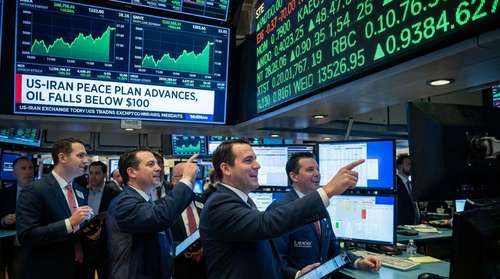
In the most significant Wall Street breaking news of the week, major U.S. equities rallied fiercely on Wednesday following reports that Washington has delivered a 15-point diplomatic proposal to Tehran. The potential de-escalation of hostilities triggered an immediate market reaction, with S&P 500 and Dow Jones Industrial Average futures surging over 1% in morning trading. This diplomatic lifeline sparked a massive relief rally, dropping global energy costs and sending the Brent crude price tumbling back under the critical $100 per barrel mark. For investors who have spent the past month on edge, this offered a profound boost to the transportation and consumer discretionary sectors.
Inside the US Iran Peace Plan
The US Iran peace plan, delivered through intermediaries in Pakistan, outlines a comprehensive path to a month-long ceasefire. According to sources familiar with the negotiations, American envoys, including Steve Witkoff and Jared Kushner, are spearheading the proposal. The 15-point framework takes a hardline stance on long-term security, demanding that Tehran completely dismantle its nuclear capabilities, hand over enriched material to the International Atomic Energy Agency (IAEA), and decommission key facilities at Natanz and Fordow.
Crucially for the global economy, the plan also requires Iran to abandon its regional proxy networks and guarantee that the Strait of Hormuz remains a free maritime zone. In exchange, Washington is reportedly offering full international sanctions relief, the removal of the UN "snapback" mechanism, and assistance in developing a civilian nuclear energy program at the Bushehr facility. While Iranian officials have publicly dismissed the idea of direct negotiations, U.S. President Donald Trump told reporters on Tuesday that talks were "productive" and noted a valuable concession related to regional energy routes.
Ongoing Military Posturing
Despite the diplomatic breakthrough, the situation on the ground remains tense. The Pentagon recently authorized the deployment of paratroopers from the 82nd Airborne Division to join the roughly 50,000 U.S. troops already stationed in the region. Iran has simultaneously fired over 1,000 missiles at neighboring Gulf states since the war began late last month. However, the mere existence of a structured off-ramp has given financial institutions the confidence to price in a de-escalation rather than a prolonged conflict.
Oil Prices Today: Crude Tumbles as the Strait Reopens
The immediate focus for financial markets has been oil prices today, which heavily dictated Wednesday's trading sentiment. Brent crude slid roughly 5% during morning trading, breaking below the $100 threshold that had recently choked global supply chains. The benchmark futures contract had surged to nearly $120 a barrel just weeks prior, after maritime traffic through the Strait of Hormuz was effectively blockaded by the rising hostilities.
The Middle East Conflict Business Impact
For weeks, the Middle East conflict business impact has remained front of mind for corporate executives. A fifth of the world's daily oil consumption flows through the Persian Gulf, and the severe disruption previously sent logistics costs skyrocketing. Now, with Iran circulating notices that "non-hostile vessels" may coordinate transit through the strategic waterway, global freight and aviation stocks are clawing back their late-winter losses. Airlines and shipping giants led the charge during Wednesday's trading session, directly benefiting from the sudden stabilization in fuel costs.
A Broad Stock Market Rally 2026 Takes Shape
The drop in energy costs is acting as a massive tailwind for equities, cementing the powerful stock market rally 2026 investors had been hoping for. Market participants have been aggressively buying the dip, shifting capital back into growth stocks that had been beaten down by fears of a prolonged energy crisis. The prospect of avoiding a long-term hot war in the Persian Gulf provides much-needed clarity for institutional investors adjusting their portfolios for the second quarter.
Beyond equities, the shift in geopolitical risk has also profoundly impacted precious metals and currency markets. Spot gold climbed over 2% to trade near $4,577 per ounce, buoyed by a softer U.S. dollar, as capital flows recalibrate to reflect a potentially stabilizing global economy. The sudden drop in volatility indexes suggests that Wall Street is increasingly betting on a diplomatic resolution.
How Inflation News Today Changes the Economic Outlook
Perhaps the most crucial secondary effect of the falling oil prices is the shifting narrative around consumer prices. The inflation news today is markedly more optimistic than it was 48 hours ago. With crude plunging, the pressure on central banks to maintain higher interest rates for a longer duration is easing significantly. The U.S. 10-year Treasury yield had been sitting above 4.4%, keeping mortgages and corporate borrowing costs painfully high. Prolonged triple-digit oil prices were widely expected to trigger a second wave of sticky inflation, potentially forcing the Federal Reserve to reconsider its monetary policy trajectory.
Now, lower energy costs are projected to dampen bond yields and ease headline inflation metrics. If the diplomatic off-ramp holds and maritime shipping returns to normal, the localized energy shock will likely act as a mere blip rather than a permanent drag on the broader economy. Traders are closely monitoring the situation in Islamabad and Tehran, knowing that any formal acceptance of the 15-point proposal will be the catalyst that turns this week's surge into a sustained, long-term bull market.