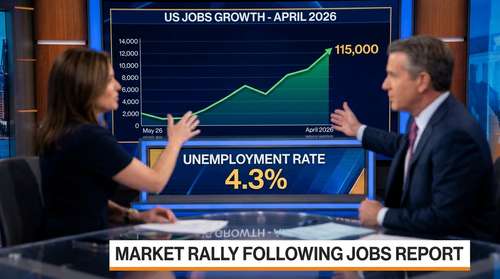
The American labor market delivered a massive upside surprise this morning, forcing economists and investors alike to completely reassess their near-term outlook. According to the latest Bureau of Labor Statistics news release, the highly anticipated April 2026 jobs report revealed that U.S. nonfarm payrolls expanded by a staggering 115,000 positions. This figure thoroughly demolished Wall Street consensus estimates, which had originally projected a much more modest gain of roughly 62,000 jobs. Simultaneously, the national unemployment rate held remarkably steady at 4.3%. This unexpected show of labor market strength has proven to be the perfect catalyst, triggering a massive stock market rally today as traders hastily recalibrate their expectations for the Federal Reserve's monetary policy and the broader US economic forecast 2026.
A Deep Dive into the US Nonfarm Payrolls Surge
While the headline jobs number is undeniably impressive, dissecting the underlying industry sectors reveals exactly where the domestic economy is maintaining its heat. The Bureau of Labor Statistics news dispatch highlighted that the healthcare sector continued its seemingly unstoppable hiring streak, adding roughly 37,000 positions in April alone. This growth aligns perfectly with its 12-month average, proving healthcare remains the foundational pillar of modern job creation.
The gains were far from isolated. The transportation and warehousing sector contributed an impressive 30,000 new jobs, heavily driven by hiring among couriers and messengers. The retail trade sector also posted strong numbers, adding another 22,000 workers to its payrolls as consumer demand remains resilient.
Conversely, the report wasn't entirely without its soft spots. Government payrolls contracted by 8,000 jobs, primarily driven by a drop in federal government employment. The information sector also shed approximately 13,000 positions, extending a cooling trend in the tech and media spaces. However, the broader context is overwhelmingly positive. March's total was revised upward to 185,000 jobs, officially confirming the first back-to-back monthly increase in US nonfarm payrolls in nearly a full year. For analysts tracking the US economic forecast 2026, this resilience is a critical indicator of enduring economic momentum despite persistent geopolitical headwinds, including the ongoing Middle East conflicts.
Wages, Inflation, and the Jobs Friday Market Reaction
Beyond the raw hiring numbers, wage growth remains the most pivotal metric for markets attempting to predict the path of inflation. In April, average hourly earnings for all private-sector employees rose by just 0.2% on a monthly basis, translating to a 3.6% increase year-over-year. This slightly cooler wage data—falling just short of the 3.8% annual forecast—was exactly the silver lining equities needed.
The combination of robust job creation and moderating wage inflation ignited a fierce stock market rally today. Wall Street thrives on the classic Goldilocks scenario—an economy that isn't running too hot to drive up inflation, nor too cold to slip into a painful recession.
This textbook Jobs Friday market reaction reflects a collective sigh of relief from institutional traders and retail investors alike. Stock futures surged well before the opening bell, driven by renewed optimism that the Federal Reserve might successfully engineer a much-debated soft landing. Even with energy prices elevated and global supply chains under pressure, the American consumer and the broader labor force appear exceptionally durable right now.
Shifting Expectations for the Federal Reserve
The Federal Reserve has kept a microscopic focus on the labor market in its fight to balance growth and price stability. With the unexpectedly strong April 2026 jobs report in hand, Fed officials led by Jerome Powell may feel entirely vindicated in their recent decision to hold interest rates steady. Now, all eyes will shift forward. Speculation is already mounting regarding what the unemployment rate May 2026 will reveal, as that will serve as the next major data point dictating monetary policy through the critical summer months. If wage pressures remain contained, the central bank will have maximum flexibility.
What This Means for the US Economic Forecast 2026
When forecasting the remainder of the calendar year, this latest batch of US nonfarm payrolls fundamentally shifts the narrative. Earlier in the first quarter, concerns of a sharp economic slowdown dominated financial headlines. The surprise contraction in February, which saw downward revisions pointing to a loss of 156,000 jobs, temporarily rattled consumer and business confidence. Now, consecutive months of positive growth demonstrate a labor market that is successfully absorbing both domestic policy shifts and international shocks.
Looking ahead, economists will closely monitor whether the current pace of hiring can broaden beyond healthcare, retail, and transportation. An unbalanced jobs market that relies too heavily on a single sector could pose long-term structural vulnerabilities. However, for the immediate future, the data provides a remarkably firm foundation for sustained consumer spending. The steady 4.3% unemployment rate means that households remain relatively secure in their earning power, maintaining their ability to drive the service-heavy American economy.
The path toward the second half of the year looks increasingly stable. If the upcoming macroeconomic data—especially the highly anticipated unemployment rate May 2026—mirrors this month's resilience, the overall US economic forecast 2026 will likely be revised upward across the board. This robust hiring environment continues to confound critics, proving once again that betting against the underlying strength of the American worker is a losing proposition.