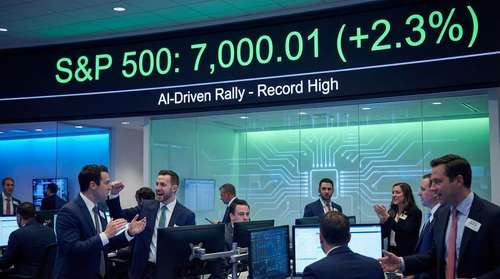
The S&P 500 has officially crossed the 7,000-point threshold for the first time in history, a monumental achievement that underscores the relentless power of the ongoing artificial intelligence boom. This record-breaking session on Wednesday, January 28, 2026, saw the benchmark index surge past the psychological barrier, driven by an explosive rally in technology stocks and renewed investor optimism. The S&P 500 7000 milestone represents more than just a number; it signals a definitive market vote of confidence in the transformative potential of AI, even as traders brace for pivotal earnings reports from industry titans later today.
AI Optimism and ASML’s Blowout Numbers Ignite Rally
While the path to 7,000 has been paved with months of steady gains, the final push was catalyzed by a stunning earnings report from semiconductor equipment giant ASML. The Dutch company, often viewed as a bellwether for the global chip industry, reported record fourth-quarter orders of €13.2 billion ($14.4 billion)—nearly double the €7 billion analysts had expected. This massive beat served as undeniable proof that the demand for advanced AI chips remains insatiable, instantly dispelling lingering fears of an “AI bubble.”
ASML’s performance sent shockwaves of positivity through the tech sector, lifting shares of Nvidia, AMD, and Broadcom. Investors interpreted the backlog surge as a green light for the entire AI ecosystem, betting that if chipmakers are buying equipment at record rates, the hyperscalers like Microsoft and Meta must be planning unprecedented infrastructure spending. This stock market record high is functionally a derivative of that belief: that we are still in the early innings of a multi-year technology supercycle.
High Stakes for "Magnificent Seven" Earnings
The market’s euphoria is heavily front-loaded ahead of what promises to be a defining afternoon for Wall Street. While the S&P 500 celebrates its new peak, traders are anxiously awaiting quarterly results from Microsoft, Meta Platforms, and Tesla, all scheduled to report after the closing bell today. The tech earnings growth narrative hinges on these reports. With valuations stretched to perfection, these companies need to not only beat earnings estimates but also provide bullish guidance on AI monetization to justify the index’s lofty new valuation.
Microsoft, in particular, is in the spotlight. Investors are laser-focused on growth figures for its Azure cloud division and uptake of its Copilot AI software. Similarly, Meta’s report will be scrutinized for signs that its massive capital expenditures on AI infrastructure are translating into ad revenue growth. The AI stock rally 2026 has been built on promises; tonight, the market demands proof of profit. A disappointment from any of these giants could dampen the celebratory mood, but for now, the momentum is undeniably bullish.
Federal Reserve Holds Steady Amid Market Exuberance
Adding to the day's drama was the Federal Reserve interest rate decision. As widely anticipated, the central bank voted to keep its benchmark interest rate unchanged at the 3.50%-3.75% range. While the decision itself was a non-event, the accompanying commentary provided a stable backdrop for the day's rally. Fed Chair Jerome Powell signaled that while inflation remains contained, the strength of the labor market allows policymakers to be patient before considering further cuts.
For equity markets, this was the "Goldilocks" outcome: an economy strong enough to support corporate earnings growth without being so hot that it forces the Fed to hike rates. The stability in monetary policy has allowed investors to focus entirely on the microeconomic success stories—primarily AI—rather than worrying about macroeconomic headwinds. This clarity from the Fed cleared the runway for the S&P 500 to make its historic leap.
SpaceX IPO Rumors Add Fuel to the Fire
Beyond the immediate earnings and rate news, Wall Street breaking news channels are buzzing with reports of a potential massive liquidity event on the horizon. Persistent rumors suggest that SpaceX is preparing for an initial public offering as early as mid-June 2026. Speculation points to a staggering valuation target of $1.5 trillion, a figure that would instantly make it one of the most valuable public companies on earth.
While still officially unconfirmed, these SpaceX IPO rumors are contributing to a general sense of "FOMO" (fear of missing out) among institutional and retail investors alike. The prospect of another trillion-dollar tech giant entering the public markets reinforces the narrative that U.S. capital markets remain the premier destination for global innovation.
Market Divergence: Tech Leads, Dow Lags
Despite the celebratory headlines, the rally is not entirely broad-based. There is a stark divergence between the tech-heavy indices and the broader market. While the S&P 500 and Nasdaq are charting new territory, the Dow Jones Industrial Average has struggled to keep pace, weighed down by weakness in traditional sectors. This bifurcation highlights a critical dynamic of the 2026 market: growth is scarce, and investors are willing to pay a premium for it, primarily finding it in the technology sector.
Simultaneously, gold prices have surged to fresh all-time highs above $5,200 an ounce, a rare occurrence where both risk assets (stocks) and safe-haven assets (gold) rally together. This anomaly suggests that while investors are chasing the S&P 500 7000 milestone, they remain hedged against potential currency devaluation and geopolitical instability.