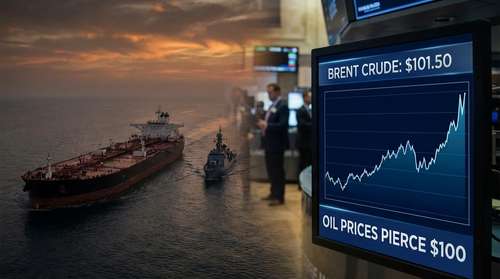
If you are monitoring oil prices today, the numbers flashing across trading desks signal a historic turning point. Over the last 48 hours, global energy markets have been fundamentally shaken. Brent crude officially surged past the psychological $100-per-barrel threshold, settling near $101.06 by Friday, March 13, 2026. The trigger is an unprecedented escalation in the Middle East, specifically surrounding the world's most vulnerable maritime chokepoint. With crude oil $100 becoming a stark reality, analysts are raising the alarm over a global energy crisis 2026 that threatens to derail post-pandemic economic stability and ignite a fresh wave of global inflation.
The Catalyst: The Strait of Hormuz Conflict
The immediate driver behind this weekend's massive price spike is the intensifying Strait of Hormuz conflict. In a rare public statement on Thursday, Iran's new Supreme Leader, Mojtaba Khamenei, warned that the critical waterway would remain closed amid ongoing military friction with the United States and Israel. Khamenei, stepping in after the escalation that claimed his father earlier this year, explicitly stated that the blockade is a retaliatory measure.
The maritime blockade is not just rhetorical posturing. According to recent advisories from UK Maritime Trade Operations, at least 13 commercial vessels have been targeted by projectiles in recent weeks, completely upending regional security. The Strait of Hormuz is the logistical heartbeat of the international oil trade, processing roughly 20% of global oil flows and a staggering 20% of global liquefied natural gas (LNG) supplies. By effectively choking off this passage, millions of barrels remain trapped in the Persian Gulf. Traders are being forced to price in severe, immediate shortages, sending shockwaves through every layer of the global supply chain.
Kharg Island and Vulnerable Infrastructure
Compounding the geopolitical anxiety is the precarious status of Kharg Island. Positioned just 25 kilometers off Iran's southwestern coast, this tiny coral outcrop handles an astonishing 90% of the nation's crude exports—loading up to 7 million barrels per day. While recent U.S. and Israeli retaliatory strikes have reportedly focused on military, naval, and air defense installations rather than energy infrastructure, the proximity of these attacks to major export hubs keeps traders on edge. Any direct hit or accidental damage to Kharg Island could push Brent and WTI futures well above $120 per barrel, representing a worst-case scenario for global logistics.
Record Interventions Fail to Tame Energy Market Volatility
Governments are scrambling to prevent an economic meltdown. The International Energy Agency (IEA) initiated its largest-ever emergency response this week, coordinating a massive 400-million-barrel release from strategic reserves of member nations. In the United States, discussions are actively underway regarding naval escorts for commercial vessels. U.S. Treasury Secretary Scott Bessent has confirmed military contingencies to secure the strait, indicating that the U.S. Navy will begin escorting tankers as soon as it is tactically viable.
Despite these historic, coordinated interventions, energy market volatility remains exceptionally high. The brief cooling effect of the IEA announcement was rapidly consumed by fresh headlines of tanker attacks and fires in the Gulf. West Texas Intermediate (WTI) futures climbed sharply alongside Brent, trading heavily in the $96 to $97 range throughout Friday morning. Such rapid, intraday fluctuations indicate that the geopolitical risk premium is deeply embedded in energy futures, and short-term patches like reserve releases are proving insufficient to calm deeply ingrained trader anxiety.
The Impact of High Oil Prices on the Global Economy
You cannot easily sequester a global energy shock. The impact of high oil prices is already bleeding into broader financial markets. On Wall Street, benchmark indices including the S&P 500, Nasdaq, and Dow Jones Industrial Average tanked over 1.5% on Thursday as the stark reality of triple-digit crude set in for investors. Corporate boardrooms across the logistics, aviation, and manufacturing sectors are bracing for severe margin compression as raw material and transportation costs surge simultaneously.
More critically, central bankers around the world are being forced to rewrite their economic playbooks. The current crisis is severely complicating the inflation forecast 2026. Over the past year, global monetary policy had been leaning toward a stabilization and recovery phase, but expensive fuel acts as a regressive tax on everyday consumers and commercial businesses alike.
Historical Context and Future Outlook
Energy analysts are drawing parallels to previous market disruptions, noting that if Brent crude sustains its position above $100—or climbs toward the 2008 peak of $147 as some investment banks warn is possible during a prolonged blockade—the resulting inflationary wave could force a return to aggressive interest rate hikes. While today's global economy is arguably less oil-intensive than during the infamous 1970s embargoes, the sheer velocity of this week's price surge creates an immediate shock.
Until diplomatic or military channels can confidently secure safe, unimpeded passage through the Strait of Hormuz, the baseline for crude appears firmly anchored in the triple digits. Market watchers and consumers alike must prepare for a turbulent spring, as high-stakes geopolitical brinkmanship continues to dictate the financial terms of global trade.