The highly anticipated summer travel season has taken a dramatic turn following the unexpected Viking Ullur grounding in Eastern Europe. On July 28, 2026, a massive rescue operation was launched after the Swiss-flagged luxury vessel ran aground on a sandbank, prompting an emergency Danube river cruise evacuation. As climate challenges intensify, the incident has shined a spotlight on the severe Europe low water levels 2026 has brought, completely upending the itinerary for nearly 200 vacationers and creating a ripple effect of cancellations across the continent.
The Dramatic Viking Cruise Ship Bulgaria Rescue
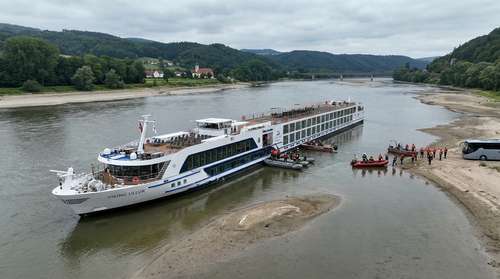
The ordeal began in the early hours of Tuesday morning, at approximately 2:20 a.m., when the Viking Ullur became firmly lodged on a shallow shoal. Navigating through the dark with reduced visibility, the vessel was traversing a stretch of the river between Romania and Bulgaria. It was scheduled to dock at the port of Vidin to resupply, but it became hopelessly stranded at river kilometer 817, roughly 25 kilometers upstream from its destination.
Carrying 186 passengers and 52 crew members, the ship quickly found itself in a precarious situation as onboard supplies of food and drinking water began to dwindle. Local shipping agents initially dispatched another vessel, the French-flagged riverboat Vivaldi, to retrieve the stranded travelers. However, the incredibly shallow waters prevented the rescue boat from getting close enough to safely transfer anyone.
This failure forced local authorities to step in, initiating the now-famous Viking cruise ship Bulgaria rescue. The Bulgarian Border Police deployed specialized, shallow-draft patrol boats to safely ferry all 186 passengers to the shore. Viking Cruises later confirmed that no injuries were reported among guests or crew. Evacuated passengers were transferred to buses to continue their modified itinerary toward Bucharest, while the 52 crew members remained aboard the stranded vessel to assist with future refloating attempts.
Unprecedented Europe Low Water Levels 2026
The grounding of this luxury Longship is a direct consequence of a prolonged environmental crisis. The Europe low water levels 2026 are shattering historical records, fueled by a relentless succession of summer heatwaves and a severe drought gripping Central and Eastern Europe. Rapid evaporation has decimated the Danube, which usually serves as Europe's second-longest and most vital inland waterway.
To understand the sheer scale of the crisis, one only has to look at the Hungarian capital. Authorities in Budapest reported that the Danube's water depth had plummeted to a shocking 9 inches (23 centimeters) this week. This shatters the previous low-water record of 33 centimeters set back in 2018. When water levels drop this drastically, standard navigation channels shrink, forcing large vessels like the 135-meter Viking Ullur into dangerously narrow and shallow corridors.
Widespread Viking River Cruise Disruptions
Unsurprisingly, the extreme weather is wreaking havoc on the broader tourism industry, leading to significant Viking river cruise disruptions. The Danube typically welcomes an estimated 600,000 international river cruise passengers annually, serving as a massive economic engine for the ten countries it borders. Now, operators are scrambling to adjust.
Vessels are being forced to dock far from their scheduled ports, and lines are increasingly relying on long-distance coach buses to shuttle tourists between passable sections of the river. In some instances, passengers are even being asked to swap ships mid-vacation to avoid the shallowest geographic bottlenecks.
Mounting Danube Drought Cruise Cancellations
For many travelers, adjustments are no longer enough. The ongoing crisis has sparked a wave of Danube drought cruise cancellations across the industry. Competitors such as Avalon Waterways have already been forced to axe several of their summer Danube sailings entirely due to the impassable conditions.
While Viking recently took delivery of a brand new longship, the 190-guest Viking Dagur, the realities of the 2026 summer season mean that navigating the Rhine, Main, and Danube rivers requires intense daily assessments. Sightseeing services to northern Hungarian towns have been suspended since mid-July, and commercial shipping, including crucial fuel imports for countries like Serbia, has been heavily restricted.
What Future Cruisers Need to Know
If you hold a booking for a European river cruise this summer or early fall, it is essential to stay in close communication with your travel operator. Lines are doing everything in their power to salvage itineraries, but Mother Nature ultimately dictates the safety of the waterways.
The successful, injury-free completion of this recent Danube river cruise evacuation proves that emergency protocols work. However, the grounding serves as a stark reminder of the vulnerability of river tourism in an era of unpredictable climate shifts. Until significant rainfall returns to Central Europe to replenish the region's parched aquifers, the mighty Danube will remain a challenging route for even the most experienced captains.