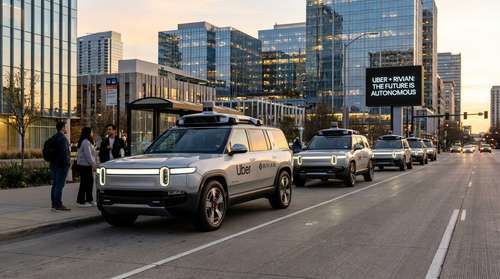
The race to dominate the next era of mobility just shifted into high gear. In a move that fundamentally accelerates the timeline for widespread driverless ride-hailing, tech giants Uber and Rivian have officially announced a landmark Uber Rivian partnership. Backed by a massive $1.25 billion investment from Uber, the deal aims to deploy up to 50,000 fully autonomous robotaxis globally over the next decade.
The strategic alliance, revealed on Thursday, centers around Rivian's highly anticipated R2 electric SUV. By combining Rivian's vertically integrated hardware and software stack with Uber's unrivaled global ride-hailing network, the two companies are positioning themselves to lead the future of transportation. For passengers waiting to experience the next evolution of transit, this collaboration represents one of the most aggressive and well-funded autonomy pushes to date, putting immense pressure on legacy automakers and tech rivals alike.
Inside the $1.25 Billion Uber Autonomous Fleet Strategy
Uber is not merely buying vehicles; it is heavily subsidizing the research and development required to make Level 4 autonomy a reality on a global scale. The financial structure of the agreement ties Uber's $1.25 billion capital injection to specific, staggered autonomous performance milestones through 2031. To kick-start the initiative, an initial $300 million investment has been committed immediately following the signing, pending standard regulatory approvals.
The rollout strategy begins with a firm commitment to purchase 10,000 fully autonomous Rivian R2 robotaxis. These vehicles will be operated either directly by Uber or through its designated fleet management partners. Crucially, these self-driving SUVs will be available exclusively on the Uber platform, ensuring that Uber reaps the direct consumer benefits of Rivian's technological leaps.
Key highlights of the deployment plan include:
- Initial Fleet: 10,000 unsupervised, Level 4 autonomous Rivian R2 units.
- Expansion Option: An agreement to negotiate the purchase of up to 40,000 additional vehicles starting in 2030.
- Target Geographies: Early testing and commercial launches in San Francisco and Miami by 2028.
- Global Scaling: Broad expansion across 25 major cities in the U.S., Canada, and Europe by the end of 2031.
The Technological Engine of the Autonomous Rivian R2
To pull off a fleet of unsupervised self-driving cars, the underlying technology has to be flawless. Rivian's approach relies on its newly detailed third-generation autonomy platform, which will first debut in consumer R2 models in late 2026. This system is engineered to be one of the most powerful sensor and compute combinations ever integrated into a consumer-grade vehicle in North America.
The autonomous Rivian R2 robotaxis will be equipped with a robust multi-modal sensor suite designed to handle unpredictable urban environments. This sophisticated array includes 11 high-resolution cameras totaling 65 megapixels, five advanced radars, and a single precise LiDAR sensor. Processing the massive influx of real-world driving data are two of Rivian's proprietary in-house RAP1 chips, which deliver a staggering 1,600 TOPS (Tera Operations Per Second) of AI compute performance.
Rivian CEO RJ Scaringe emphasized that the scale of the company's growing data flywheel, combined with its state-of-the-art inference platform, makes rapid advancement highly achievable. "We couldn't be more excited about this partnership with Uber," Scaringe noted during the announcement. "It will help accelerate our path to level 4 autonomy to create one of the safest and most convenient autonomous platforms in the world".
How This Impacts Self-Driving Cars in 2026 and Beyond
The autonomous vehicle sector has seen its share of turbulence over the past few years, with several rivals facing regulatory scrutiny and technical setbacks. However, Uber CEO Dara Khosrowshahi pointed to Rivian's holistic manufacturing model as a key differentiator in a crowded market. Designing the vehicle, the compute platform, and the software stack entirely in-house gives Rivian a level of end-to-end quality control that few competitors can match. Khosrowshahi stated that this vertical integration gives Uber "conviction to set these ambitious but achievable targets".
This Uber Rivian partnership is also a critical component of Uber's broader strategy to cement itself as the definitive digital infrastructure for driverless ride-hailing. The company is strategically diversifying its autonomy portfolio rather than placing all its bets on a single manufacturer. Alongside the Rivian deal, Uber has established operational agreements with Waymo, holds a recent $300 million investment in Lucid Group for up to 20,000 robotaxis, and plans to introduce Volkswagen ID. Buzz autonomous minivans in Los Angeles later this year.
By locking down exclusive platform rights to Rivian's massive upcoming fleet, Uber ensures that whichever automaker masters autonomy first, passengers will still book their rides through the Uber app. As the automotive industry races toward a fully driverless reality, this historic agreement stands as a billion-dollar statement that the future of transportation is arriving faster than previously imagined.