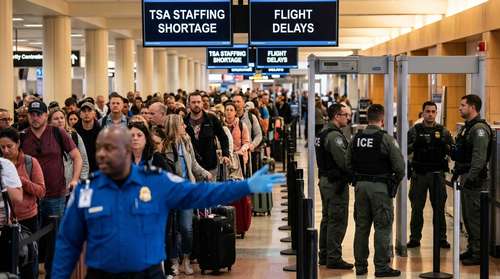
The ongoing partial government shutdown of the Department of Homeland Security (DHS) has plunged American air travel into unprecedented turmoil. Entering its sixth week, the funding lapse has triggered a massive TSA staffing shortage 2026, leaving tens of thousands of transportation security officers working without pay. The resulting bottleneck has produced monumental wait times at security checkpoints nationwide, leaving frustrated passengers stranded and forcing the Trump administration to deploy ICE agents to assist with basic airport operations. With the peak travel season officially underway, the situation is rapidly evolving from a political standoff into a nationwide transit emergency.
The Scope of Airport Chaos March 2026
As lawmakers remain deadlocked over immigration enforcement funding, the DHS shutdown travel impact is being felt most acutely at the terminal gates. Over 61,000 Transportation Security Administration employees have been working without paychecks since mid-February. The financial strain is pushing the workforce to its breaking point, forcing many screeners to take second jobs or call out entirely.
According to recent DHS reports, more than 480 TSA officers have already resigned to seek stable income. Meanwhile, daily absentee rates have skyrocketed, reaching nearly 12 percent nationally. Major hubs are experiencing the brunt of the crisis; facilities like Atlanta's Hartsfield-Jackson and Houston's George Bush Intercontinental have reported staggered call-out rates approaching 40 percent.
The prolonged standoff is not just a logistical nightmare but a looming financial crisis. Industry experts warn that the ongoing operational drag could result in billions of dollars in economic damage if it stretches further into the spring. Smaller regional airports are facing an even more precarious situation, with acting TSA officials warning that some facilities might have to temporarily suspend operations altogether if local staffing levels dip too low to maintain essential security protocols.
Spring Break Travel Warnings 2026
The timing of the political impasse could not be worse for the travel industry. Airlines for America projects a record-breaking 171 million passengers will fly during this period, representing a 4 percent increase from last year. Industry experts and aviation authorities are issuing severe Spring Break travel warnings 2026, urging vacationers to prepare for significant disruptions. At some facilities, like Louis Armstrong New Orleans International Airport, security lines have routinely snaked out of terminal buildings and into adjacent parking areas.
ICE Agents at Airports: A Controversial Fix
To mitigate the sprawling US airport security lines today, President Trump recently authorized the deployment of Immigration and Customs Enforcement (ICE) personnel to severely impacted airports. While they are not trained to operate X-ray machines or conduct physical screenings, these federal officers are stepping in to manage crowd control, monitor secure exit lanes, and assist passengers with their luggage.
The administration has also suggested that the National Guard could be mobilized if the situation deteriorates further. While the presence of ICE agents at airports has provided some logistical relief to overworked TSA screeners, the move has drawn sharp criticism from Democratic lawmakers who argue that utilizing immigration enforcement officers in domestic transit hubs will only heighten traveler anxiety.
Missed Flights TSA Delays: What Are Your Rights?
For passengers caught in the crossfire, the immediate concern is simply making it to their gate on time. Wait times are stretching beyond three hours at several major hubs, causing a nationwide surge in missed flights TSA delays.
Unfortunately, travelers missing their departures due to understaffed security checkpoints have limited recourse. Standard travel insurance policies generally do not cover delays caused by TSA lines, categorizing them as foreseeable events. Airlines are legally under no obligation to issue full refunds for flights missed because of government-induced security backups.
However, several major carriers have introduced temporary waivers to help stranded customers. Airlines like American and United are largely waiving change fees or allowing passengers to rebook free of charge on the next available flight, provided seats are open.
Strategies for Navigating the Terminals
If you are flying in the coming weeks, thorough preparation is your best defense against the disruptions:
- Arrive Early: The standard two-hour rule no longer applies. Budget at least three to four hours for domestic flights, particularly if flying out of major international hubs.
- Use Airline Apps: Real-time wait tracking on official airport websites has been suspended in several cities due to the volatility of the lines. Use your airline's mobile app to quickly rebook if you realize you are going to miss your boarding window.
- Leverage Frequent Flyer Status: Travelers with elite airline status or memberships in expedited screening programs like TSA PreCheck or CLEAR may still experience delays, but these dedicated lanes are generally moving faster than standard security queues.
With Congress scheduled to leave for an Easter recess soon, the window to pass a DHS funding agreement is closing rapidly. Until lawmakers reach a compromise, American travelers will continue to bear the brunt of the gridlock.