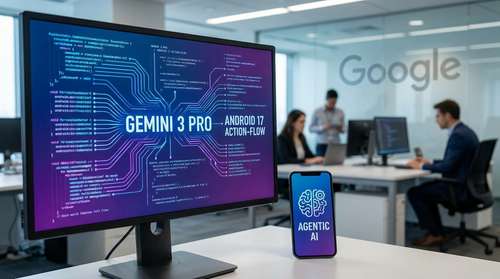
Google has officially commenced the global Gemini 3 Pro rollout, marking a pivotal shift in how artificial intelligence operates within both consumer and enterprise environments. Far from a standard chatbot update, this release introduces genuine Agentic AI technology to the mainstream, signaling a departure from passive query-response models. Paired with the surprise launch of an autonomous research agent called Deep Research Max Google, and highly anticipated Android 17 Action-Flow leaks, the Mountain View tech giant is demonstrating that 2026 is the year AI transitions from answering questions to executing complex, real-world tasks independently.
The Dawn of Agentic AI: Inside the Gemini 3 Pro Rollout
The industry has been anticipating a shift toward systems that take autonomous action, and the Gemini 3 Pro framework delivers precisely that. Built upon the robust reasoning foundation of the Gemini 3.1 architecture, this latest iteration demonstrates unprecedented depth in multimodal understanding. It processes text, video, live telemetry streams, and complex codebases natively. Instead of relying on manual, step-by-step prompting from a user, the model synthesizes disparate pieces of information to execute multi-step tasks seamlessly.
This leap forward is especially evident in the developer space. Software engineers are already leveraging the new API via Google AI Studio to build intelligent personal assistants capable of navigating server environments and generating functional code autonomously. By prioritizing robust function calling and persistent context across extended interactions, Google is pushing the envelope on what a consumer-facing AI can accomplish. The focus has firmly shifted toward efficiency, tangible action, and eliminating the friction historically associated with complex software development.
Deep Research Max: Google's Autonomous Data Powerhouse
Perhaps the most disruptive element among the recent Google AI ecosystem updates is the introduction of Deep Research Max. Distinct from standard search models designed to provide immediate, bite-sized summaries, this high-tier autonomous agent was built specifically for exhaustive, long-horizon data synthesis.
Redefining Enterprise Workflows
When tasked with a dense analytical query, Deep Research Max does not simply scrape the first page of search results. It formulates a comprehensive research plan, runs dozens of iterative search loops, cross-references conflicting evidence, and distills the gathered data into a heavily cited, professional-grade report. Furthermore, through the newly integrated Model Context Protocol (MCP), it securely connects with proprietary enterprise feeds—such as internal financial databases or platforms like PitchBook—treating them as just another searchable context.
This capability enables asynchronous background workflows. An investment team can trigger a batch of deep-dive due diligence reports before leaving the office, knowing the agent will spend the night analyzing SEC filings and peer-reviewed journals. By morning, the team receives fully sourced analyses complete with native charts and visualizations. This represents a monumental leap in enterprise productivity.
Android 17 Action-Flow Leaks: A New Era of Mobile Autonomy
While the enterprise sector reaps the benefits of heavy cognitive computing, the consumer space is generating equal excitement due to recent leaks. Insiders have revealed that the upcoming mobile operating system will feature a natively integrated framework, heavily referenced in the latest Android 17 Action-Flow leaks.
These leaks suggest Action-Flow will empower AI agents to securely execute complex, cross-app operations entirely in the background. Imagine organizing an international vacation: rather than manually toggling between a web browser, a calendar app, an airline portal, and a banking application, the Action-Flow system can coordinate end-to-end travel booking and financial management. The AI handles the logistics without requiring granular manual user input at every step.
This architecture essentially transforms the smartphone from a passive tool into an autonomous digital concierge. Naturally, security researchers are closely monitoring how Google plans to manage app permissions and privacy capsules within this new framework, but the potential utility is undeniable.
Google I/O 2026 Predictions: Unifying the Tech Ecosystem
With these massive developments arriving just weeks before Google's premier developer conference on May 19 and 20, the tech community is buzzing. Top Google I/O 2026 predictions point toward an event entirely dominated by the rise of autonomous AI agents 2026. The Shoreline Amphitheatre keynote is perfectly timed to stitch these fragmented innovations into a single, cohesive narrative.
Expect Google executives to highlight how Gemini 3 Pro serves as the foundational reasoning layer across all devices, while Deep Research Max handles the heavy analytical lifting for the enterprise sector. Concurrently, Android 17 will bring everyday agentic utility directly to billions of mobile users. Alongside rumored hardware teasers and potential updates to Android XR glasses, Google is clearly positioning its entire ecosystem to run intelligently and autonomously in the background of our daily lives.
The transition from reactive chatbots to proactive software is no longer just a roadmap concept—it is a tangible reality. As developers integrate these powerful APIs and consumers prepare for the next wave of mobile updates, the technology landscape is rapidly adapting to an era where your devices work for you, independently and securely.