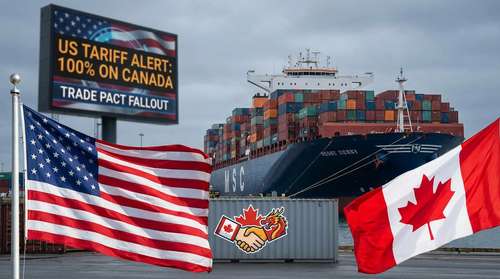
President Donald Trump has issued his most severe economic warning to date against America's northern neighbor, threatening to impose a blanket 100% tariff on all Canadian goods if Ottawa proceeds with a new trade agreement with China. In a blistering statement released on Truth Social this Saturday, Trump accused Canadian Prime Minister Mark Carney of attempting to position Canada as a backdoor for Chinese products to flood the U.S. market, reigniting fears of a full-scale US Canada trade war in 2026.
The "Drop Off Port" Accusation
The escalation comes just days after reports emerged of a preliminary agreement between Ottawa and Beijing regarding electric vehicles and agricultural exports. President Trump, who has made protectionist trade policies a cornerstone of his administration, wasted no time in condemning the move. Using his social media platform, he alleged that the new deal would effectively render the United States-Mexico-Canada Agreement (USMCA) void by allowing Chinese goods to bypass U.S. levies.
"If Governor Carney thinks he is going to make Canada a 'Drop Off Port' for China to send goods and products into the United States, he is sorely mistaken," Trump wrote, deliberately using Carney's former title as Bank of Canada Governor to diminish his standing as Prime Minister. "China will eat Canada alive, completely devour it, including the destruction of their businesses, social fabric, and general way of life."
The President concluded his post with a definitive ultimatum: "If Canada makes a deal with China, it will immediately be hit with a 100% Tariff against all Canadian goods and products coming into the U.S.A."
The Deal Behind the Dispute: EVs for Canola
At the heart of this explosive diplomatic row is a specific reciprocal arrangement negotiated by the Carney administration. According to trade officials, the Canada China trade deal involves Canada allowing the import of approximately 49,000 Chinese electric vehicles (EVs) at a reduced tariff rate of 6.1%. In exchange, Beijing has agreed to lower import duties on Canadian canola and other agricultural products—a sector that has faced significant volatility in recent years.
While the deal was framed by Ottawa as a necessary move to diversify export markets and lower consumer costs for green technology, the White House views it as a betrayal of North American economic solidarity. Trump’s characterization of Canada as a transshipment hub suggests he believes these Chinese EVs could eventually leak into the U.S. market, undermining American auto manufacturers who are shielded by high tariff walls.
Trade Minister Denies "Free Trade" Label
Attempting to cool the rhetoric, Canada’s Minister of Trade Dominic LeBlanc clarified late Saturday that the arrangement does not constitute a comprehensive free trade agreement. "There is no pursuit of a free trade deal with China," LeBlanc stated. "What was achieved was a resolution on several important tariff issues to benefit Canadian farmers and consumers." Despite these assurances, the threat of US trade sanctions in 2026 remains high as Washington scrutinizes the details of the pact.
Carney's Response: "Buy Canadian"
Prime Minister Mark Carney, who has frequently clashed with Trump since taking office, responded to the threat not with direct confrontation, but with a call for domestic economic resilience. In a video address released Sunday morning, Carney urged citizens to prioritize local industries, implicitly acknowledging the potential for a severe economic shock.
"We cannot control what other countries do, but we can be our own best customer," Carney said, launching a renewed "Buy Canadian" initiative. "We will build a strong Canada together, regardless of external pressures."
The Prime Minister's measured tone contrasts sharply with the aggressive stance from Washington. However, political analysts note that Mark Carney's trade policy is facing its stiffest test yet. By pivoting slightly toward China to offset U.S. unpredictability, Carney risks alienating Canada's largest trading partner at a critical moment—just as the USMCA is up for review.
Economic Fallout: A North American Crisis?
If implemented, a 100% tariff would be catastrophic for the North American economic impact. Canada and the U.S. share one of the world's largest trading relationships, with over $2 billion in goods and services crossing the border daily. A tariff of this magnitude would effectively halt most cross-border commerce, devastating supply chains in the automotive, energy, and manufacturing sectors.
Economists warn that the 100 percent tariff threat alone could chill investment. "This is uncharted territory," said Sarah Jenkins, a senior trade analyst in Toronto. "Even a temporary disruption of this scale would trigger a recession in Canada and significantly spike inflation in the United States. It's a lose-lose scenario that turns a trade dispute into a continental crisis."
As markets open on Monday, all eyes will be on whether the Trump administration takes formal steps to enact these levies or if this remains a high-stakes negotiation tactic. For now, the prospect of a debilitating trade war looms larger than at any point since the original NAFTA renegotiations.