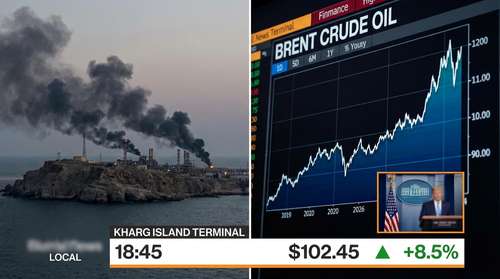
In a dramatic escalation of the ongoing Middle East conflict 2026, U.S. forces have executed a devastating precision assault on Iran's most critical energy hub. President Donald Trump confirmed on Saturday that the U.S. military struck Kharg Island, neutralizing dozens of strategic threats while deliberately sparing the country's crude export facilities. Despite the surgical nature of the operation, the massive Trump Iran strike has triggered global economic panic, sending oil prices soaring above $100 a barrel.
The Kharg Island Attack: 90 Targets "Obliterated"
Located roughly 15 miles off the Iranian mainland in the Persian Gulf, Kharg Island serves as the beating heart of Tehran's oil-based economy, handling approximately 90 percent of the nation's crude exports. Late Friday night, the United States launched what has been described as one of the most powerful bombing raids in the history of the region.
Taking to his preferred social media platform, the 47th President Truth Social post declared that American forces had "totally obliterated every MILITARY target in Iran's crown jewel". The operation was designed to preemptively eliminate Tehran's ability to fortify the island's defenses and disrupt international shipping lanes.
According to the latest Central Command Iran strikes briefing, U.S. forces successfully destroyed more than 90 military targets. The comprehensive bombardment leveled naval mine storage facilities, missile storage bunkers, the airport control tower, and an offshore helicopter hangar, completely neutralizing the island's immediate offensive capabilities.
Global Oil Prices Surge Amid Energy Market Panic
Despite the sheer scale of the Kharg Island attack, U.S. forces explicitly avoided damaging the petroleum infrastructure. President Trump noted that "for reasons of decency," he chose not to wipe out the oil facilities. However, he issued a stark ultimatum to Tehran: if Iranian forces continue to threaten the free and safe passage of ships through the Strait of Hormuz, he will "immediately reconsider this decision".
The geopolitical shockwaves were immediate. We are witnessing an unprecedented oil prices surge as crude values skyrocketed past the $100-a-barrel threshold. The Trump administration, which launched "Operation Epic Fury" last month, has even temporarily lifted sanctions on Russian oil shipments to help stabilize a volatile global energy market.
With roughly one-fifth of the world's oil supply relying on the Strait of Hormuz, the stakes could not be higher. To alleviate supply chain blockades, Trump announced that the U.S. Navy will begin aggressively escorting commercial tankers through the strait "very soon," establishing a protected maritime corridor for international trade.
US Iran War News: Entering a Volatile Third Week
As the broader war enters its third week, the latest US Iran war news paints a picture of a rapidly expanding regional crisis. Iranian officials have struck a defiant tone in the wake of the Kharg Island bombardment. Foreign Minister Abbas Araghchi warned that Tehran would aggressively retaliate by targeting regional energy infrastructure belonging to American companies or their shareholders.
Gulf States Caught in the Crossfire
The fallout is already spilling over into neighboring nations. The United Arab Emirates has found itself increasingly in the crosshairs of Tehran's proxy network. On Saturday alone, UAE defense systems successfully intercepted nine ballistic missiles and 33 suicide drones launched from Iranian territory, resulting in a minor fire in Fujairah but fortunately no reported casualties.
Iran has falsely accused the U.S. of using ports and hideouts in the UAE to launch the Kharg Island offensive, openly urging civilians to evacuate the Middle East's busiest maritime hubs. This rhetoric marks a dangerous new phase in the conflict, representing the first time Tehran has explicitly threatened a neighboring country's non-U.S. assets.
What Happens Next?
The strategic ball is now firmly in Tehran's court. While Iranian state media, including the Fars news agency, has attempted to downplay the severity of the strikes by confirming that oil exports are continuing normally, the military reality on the ground tells a different story. The total destruction of Kharg Island's defensive perimeter leaves Iran's economic lifeline entirely exposed to future U.S. military action.
As the Pentagon reportedly deploys an additional 2,500 U.S. Marines to the region, the international community remains on high alert. Whether this overwhelming show of force compels Iran to reopen the Strait of Hormuz or triggers a catastrophic regional energy war will be determined in the critical days ahead.