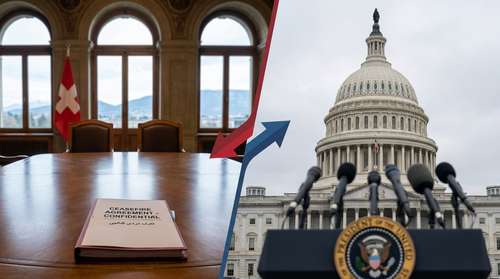
President Donald Trump has officially announced his intention to submit the highly anticipated Trump Iran ceasefire deal to Capitol Hill, attempting to quell a growing storm of bipartisan backlash. After nearly four months of intense military conflict that began on February 28, the sudden announcement of a peace agreement has left many lawmakers demanding immediate transparency. While the administration promises economic relief and an end to hostilities, the secretive nature of the initial agreement has sparked intense scrutiny over what concessions the United States has made to Tehran.
Pushing for a US Iran MOU Congress Review
As the administration prepares to release the finalized text within the next 48 hours, demands for a comprehensive US Iran MOU Congress review are echoing across both sides of the political aisle. Bipartisan lawmakers have heavily criticized the White House for keeping Congress largely in the dark during the rapid mediation process. Senator Raphael Warnock (D-GA) captured the widespread skepticism, questioning the ultimate achievements of the war and pointing out that the current resolution strongly resembles the geopolitical landscape before the conflict even began.
Administration allies have actively attempted to temper expectations regarding the initial document. Vice President J.D. Vance recently acknowledged that the memorandum of understanding is a "very general document," further fueling congressional anxiety. Lawmakers are insisting on a thorough examination of the draft before any permanent commitments are solidified, emphasizing that robust congressional oversight is non-negotiable when dealing with global security and complex international treaties.
The Strait of Hormuz Reopening 2026 & Economic Impact
A central pillar of the newly brokered peace is the Strait of Hormuz reopening 2026, a critical development for the globally strained energy sector. In exchange for Iran unblocking the vital waterway—which handles a massive portion of the world's oil supply—the United States has agreed to terminate its naval blockade on Iranian ports. President Trump celebrated the diplomatic breakthrough on social media, proclaiming, "Let the oil flow!"
The economic impact of this reopening was immediate and dramatic. Global oil prices, which had surged past $100 per barrel during the height of the conflict and prompted Trump to propose suspending the federal gas tax, plummeted back toward $83 shortly after the announcement. Stock markets across Asia, Europe, and the United States rallied on the prospect of restored energy supply chains. However, former State Department officials argue that trading the reopening of the strait for the lifting of the blockade merely restores the status quo, effectively rewarding Tehran for holding the global economy hostage.
Setting the Stage: Switzerland Signing Ceremony June 19
The international community is now looking ahead to the formal Switzerland signing ceremony June 19. This historic event will take place at the heavily secured Bürgenstock resort, an isolated mountainside venue nestled near Lucerne. Facilitated by key mediators from Pakistan and Qatar, this highly anticipated formal setting will solidify the initial ceasefire and establish a framework for ongoing diplomacy between the rival nations.
This ceremony marks the beginning, rather than the end, of the negotiation process. According to diplomatic sources, the signing will initiate a strict 60-day diplomatic window. During this critical period, negotiators will be forced to tackle more complex and deeply entrenched issues that were excluded from the immediate ceasefire framework.
The Critical 60-Day Diplomatic Window
Iranian Deputy Foreign Minister Kazem Gharibabadi confirmed that a more expansive agreement would be negotiated during this two-month period. Diplomats will have to navigate treacherous waters to convert this preliminary pause in fighting into a lasting peace architecture, particularly concerning sanctions relief.
Navigating US Middle East War Politics
The recent conflict has drastically reshaped US Middle East war politics, especially with the November midterm elections rapidly approaching. Surging gas prices and regional instability had quickly become significant political liabilities for the Republican party. By securing a ceasefire, the administration hopes to alleviate domestic economic pressures and present a decisive victory to frustrated American voters.
However, the regional dynamics remain highly volatile and dangerous. Israel, which joined the US in initial strikes against Iran, remains deeply entrenched in a parallel conflict with Hezbollah in Lebanon. Iranian Foreign Minister Abbas Araghchi has aggressively suggested that the peace deal requires a full Israeli withdrawal from Lebanese territory—a condition firmly rejected by Israeli Prime Minister Benjamin Netanyahu. These conflicting interpretations threaten to derail the fragile stability achieved by the new agreement.
Analyzing the Trump Iran Agreement Details
As security experts begin parsing the limited Trump Iran agreement details, it is overwhelmingly clear that many foundational issues remain unresolved. The immediate focus is solely on rapid de-escalation: pausing military strikes, ending blockades, and ensuring the free flow of maritime navigation. The fate of Iran's controversial nuclear program, a primary catalyst for historical tensions, has been intentionally deferred to the second stage of talks.
For now, the administration is banking heavily on the immediate economic relief provided by the ceasefire to justify its broader diplomatic strategy. Yet, as the unredacted text of the agreement finally heads to Congress, the White House faces an uphill battle to prove that the deadly four months of warfare ultimately yielded a tangible strategic victory, rather than a devastatingly costly return to square one.