
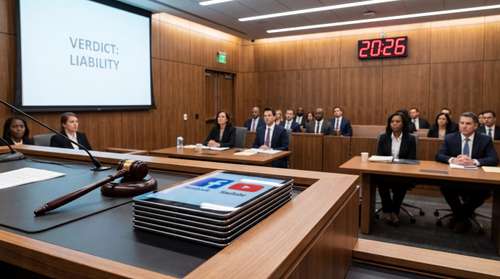
A Los Angeles jury has delivered a massive blow to Silicon Valley, handing down a historic Meta Google social media addiction verdict that could fundamentally alter the future of the internet. On Wednesday, March 25, 2026, jurors awarded $6 million in damages to a young California woman who suffered severe psychological harm after being algorithmically hooked on Instagram and YouTube as a child. The decision marks the very first time American tech giants have been held financially liable by a jury for the psychological toll of their platform engineering. Legal experts and child safety advocates are already calling the ruling a tech industry Big Tobacco moment, setting a massive precedent that threatens to upend the engagement-driven business models that have dominated the digital age.
The Landmark Social Media Liability Lawsuit of 2026
The closely watched social media liability lawsuit 2026 centered around a plaintiff identified in court records as K.G.M., or Kaley. During the grueling seven-week trial, the 20-year-old testified that she began using YouTube at age six and Instagram at age nine, rapidly developing a severe behavioral addiction. Kaley described spending "all day long" on the platforms, which she testified directly fueled her severe depression, body dysmorphia, and suicidal ideation by the time she was ten years old.
After over 40 hours of intense deliberation, the panel of jurors concluded that both Meta and Alphabet's Google were legally negligent. They found that the tech behemoths designed platforms that intentionally fostered addiction without adequately warning minor users or their parents of the inherent dangers. The jury awarded $3 million in compensatory damages and an additional $3 million in punitive damages, concluding that the companies acted with malice, fraud, or oppression. Under the ruling, Meta shoulders 70% of the financial burden, while Google is responsible for the remaining 30%.
Bypassing Section 230 Tech Liability
For decades, internet companies have shielded themselves behind Section 230 of the Communications Decency Act, effectively avoiding lawsuits over user-generated content. However, this Instagram YouTube mental health trial succeeded by pivoting the legal argument entirely. Instead of focusing on the specific videos or photos hosted on the platforms, the plaintiff's legal team put the underlying social media design ethics on trial.
By arguing that features like infinite scroll, autoplay algorithms, and augmented reality beauty filters function as inherently defective products, attorneys successfully circumvented traditional Section 230 tech liability protections. The jury agreed that the engineering itself—not the content it delivered—was a substantial factor in causing the plaintiff's harm.
During the proceedings, defense attorneys representing Meta and Google attempted to shift the blame, underscoring emotional challenges in the plaintiff's home life and pointing out that her childhood therapist had not formally documented social media as the primary catalyst for her distress. Ultimately, the jury rejected this defense, holding the tech giants directly accountable for their engineering choices.
Tech Giants Push Back Against the Verdict
Both tech behemoths strongly contested the ruling and vowed to fight back. Meta announced plans to evaluate its legal options and appeal the decision, stating that adolescent mental health is profoundly complex and cannot be linked to a single application. Google also intends to appeal, with a spokesperson arguing that the verdict fundamentally mischaracterizes YouTube, which they insist is a "responsibly built streaming platform," rather than a traditional social network.
Despite their pushback, the legal and financial pressure is mounting at a staggering pace. The Los Angeles decision arrived less than 24 hours after a separate New Mexico jury ordered Meta to pay $375 million in a state lawsuit concerning the company's failure to protect children from predators, signaling a disastrous week for the tech empire.
What This Means for Digital Safety Regulation
While a $6 million judgment is essentially a rounding error for companies valued in the trillions, the dollar amount is entirely beside the point. This was a "bellwether" case—a critical test trial designed to gauge how juries will respond to complex product liability theories. There are currently thousands of similar lawsuits consolidated in multidistrict litigation across the United States waiting for their day in court.
"Today's verdict is a referendum — from a jury, to an entire industry — that accountability has arrived," stated Joseph VanZandt, co-lead counsel for the plaintiff.
The comparison to Big Tobacco is no longer just a rhetorical device used by critics; it is a tangible legal reality. Just as cigarette manufacturers were eventually forced to redesign their marketing and face strict federal oversight, platforms like Instagram and YouTube may face a similar fate. Regulators are already eyeing these court victories as a foundation for sweeping legislative changes aimed at protecting minors online.
Legal analysts suggest this massive legal precedent will accelerate aggressive digital safety regulation and spark a wave of new litigation. If appellate courts uphold the verdict, Silicon Valley will be forced to drastically rethink how it engineers consumer technology. Platforms may soon have no choice but to abandon the hyper-optimized, addictive engagement loops that have driven their massive advertising revenues for over a decade. For the tech industry, the era of unchecked self-regulation appears to be coming to a rapid, incredibly costly end.