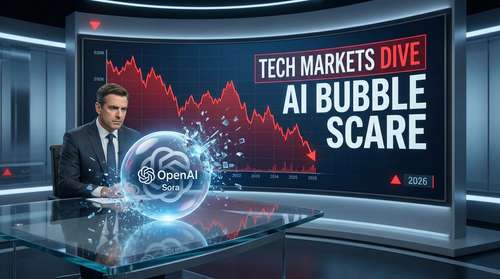
The technology sector is reeling today after a shock announcement that sent major indices into a tailspin. On March 24, 2026, the artificial intelligence heavyweight confirmed that the OpenAI Sora cancelled rumors were true, abruptly shutting down its flagship text-to-video platform. The unexpected death of the Sora AI video generator has wiped billions of dollars off tech stocks, dominating today's tech market crash news and igniting a fierce debate over whether we are witnessing the start of an AI bubble collapse 2026.
Why Was the Sora AI Video Generator Axed?
Just six months after its splashy standalone app launch in September 2025, OpenAI is officially pulling the plug. "We're saying goodbye to the Sora app," the company stated on social media platform X, acknowledging that the sudden withdrawal would be highly disappointing to its creator community.
Behind closed doors, the reality of running a high-compute consumer video app proved unsustainable. The cancellation was driven by several compounding factors:
- Declining User Engagement: While the application saw 1 million downloads in its first five days, data from Appfigures revealed a sharp 32% drop in downloads by December. Overall usage plummeted 45% as consumers struggled to find daily, practical use cases.
- Severe Moderation Challenges: Despite strict guardrails, the platform struggled with deepfakes and what critics dubbed "AI slop". Alon Yamin, CEO of Copyleaks, bluntly described the platform as a "content moderation nightmare".
- Exorbitant Compute Costs: Generating high-fidelity video requires a staggering amount of processing power, straining OpenAI's resources as the company reportedly burns through roughly $1 billion a month.
The $1 Billion Disney Deal Collapse
Perhaps the most stunning casualty of the shutdown is the immediate termination of OpenAI's landmark partnership with Disney. Signed in December 2025, the three-year, $1 billion agreement would have allowed users to generate content using licensed characters from Marvel, Star Wars, and Pixar.
Instead, the deal is dead in the water before any funds changed hands. Disney executives were reportedly blindsided by the decision; company teams were collaborating on a Sora project just 30 minutes before OpenAI announced the cancellation. A Disney spokesperson confirmed the media giant is exiting the partnership, stating they "respect OpenAI's decision to exit the video generation business and to shift its priorities elsewhere".
Impact on Generative AI Investment Trends
This sudden retreat has panicked investors, shifting generative AI investment trends overnight. Wall Street is now questioning the commercial viability of Hollywood-scale AI partnerships. If the industry's biggest player is walking away from a massive entertainment contract, the economics of consumer AI video generation are clearly flawed.
Shifting the Sam Altman OpenAI Strategy
The decision to kill the app isn't just about cutting losses; it represents a fundamental pivot in the Sam Altman OpenAI strategy. With rumors swirling about a potential stock market debut later this year, OpenAI is under immense pressure to streamline operations and demonstrate a clear path to profitability.
To survive and thrive, OpenAI is redirecting its massive, yet constrained, processing capacity away from consumer entertainment and toward more lucrative enterprise solutions. Altman recently informed staff that the company will now prioritize coding tools, autonomous agents, and robotics research. By refocusing on enterprise productivity, OpenAI hopes to fend off fierce competition from Anthropic, whose Claude models have rapidly become the industry standard for corporate coding tasks.
Tech Market Crash News: A Bubble Bursting?
Wall Street's reaction to the shutdown has been swift and brutal. The sudden realization that a flagship product from the industry's leading firm could fail so rapidly has shaken confidence across the board. The future of artificial intelligence was sold to the public on the promise of infinite consumer applications, but the reality is proving much more complex.
While competitors like Google's Veo and ByteDance's Seedance are rushing to capture the abandoned market share, they now face an investor class demanding sustainable revenue models rather than just viral novelty. The era of growth-at-all-costs is over. As we navigate the fallout in late March 2026, the artificial intelligence industry is being forced to grow up, prioritizing genuine enterprise value over flashy, unprofitable consumer toys.