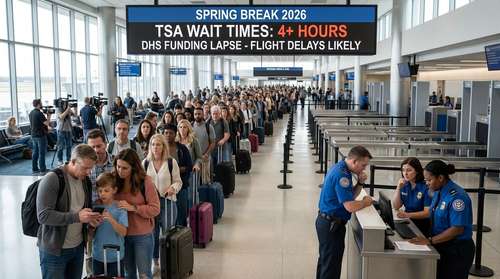
The partial government shutdown of the Department of Homeland Security (DHS) has officially reached a breaking point, sparking unprecedented chaos across the United States aviation network. As of Friday morning, thousands of Transportation Security Administration (TSA) agents are missing their second consecutive paycheck. The resulting staffing shortage has created record airport security delays and sprawling TSA wait times that are stretching past the four-hour mark at major hubs. With the crisis peaking squarely during the busy Spring Break travel season, passengers are now being urged to arrive at the airport up to five hours before their scheduled departures to ensure they make their flights.
Spring Break Travel News: Airport Lines Stretch for Hours
The DHS shutdown 2026 entered its 42nd day today, leaving over 100,000 homeland security employees—including 50,000 TSA screeners—without compensation. The financial strain has led to severe staffing deficits just as airports are attempting to process nearly 3 million passengers per peak travel day. According to the agency, callout rates have surged nationwide, with Houston Hobby International Airport reporting a staggering 55% absence rate earlier this month.
For travelers trying to navigate the government shutdown airport impact, the scene on the ground is grim. Passengers in Atlanta, Houston, and New York have reported lines snaking out of the terminals and into parking garages. Airlines are doing their best to mitigate the damage by waiving rebooking fees for passengers who miss their flights due to the airport security delays, but the sheer volume of stranded travelers means alternative flights are frequently booked solid for days. If you are flying this weekend, constantly monitoring flight status updates and airline advisories is no longer optional—it is a mandatory step for any successful journey.
The Human Cost of the TSA Funding Crisis
While the political standoff over immigration enforcement continues in Washington, the frontline workers securing the nation's skies are enduring severe financial hardship. Acting TSA Administrator Ha Nguyen McNeill recently testified before Congress, revealing the dire circumstances facing the unpaid workforce. Over the course of the shutdown, nearly 500 transportation security officers have quit the agency outright, severely hampering the TSA's ability to maintain normal checkpoint operations.
The ongoing TSA funding crisis has forced some essential workers to resort to extreme measures, including donating plasma and sleeping in their vehicles, just to cover basic living expenses. To make matters worse, workplace conditions have rapidly deteriorated. The TSA reports a staggering 500% increase in the frequency of passenger assaults on officers since the funding lapse began, as frustrated crowds take their anger out on the remaining skeleton crews. By today, the agency's unpaid payroll backlog has reached approximately $1 billion.
Emergency Orders and Legislative Breakthroughs
Mounting pressure from airlines, travelers, and local officials has finally prompted action in the nation's capital. On Thursday, President Donald Trump announced an executive order directed at newly sworn-in DHS Secretary Markwayne Mullin to immediately restore pay for TSA agents. Administration officials indicated they plan to repurpose funds from last year's One Big Beautiful Bill Act, which originally allocated tens of billions of dollars for events like the 2026 FIFA World Cup and various state grants.
The standoff originally stemmed from deep partisan disagreements regarding border security and immigration enforcement. Senate Democrats demanded accountability measures and reforms for U.S. Immigration and Customs Enforcement (ICE) following controversial operations, while Republicans initially refused to advance funding bills that restricted the agency's enforcement capabilities. However, a more permanent legislative fix is now on the horizon. Early Friday morning, the Senate unanimously approved a funding package for most of the DHS. The bill now heads to the House. If passed, it would end the sweeping furloughs and financial freezes that have paralyzed the department's operations, though aviation experts warn it could still take months to fully replace the officers who have permanently resigned.
Navigating the Travel Chaos: What You Need to Know
Until normal operations resume and staffing levels stabilize, passengers must drastically alter their airport routines. The combination of depleted security forces and surging Spring Break crowds leaves virtually no margin for error.
Essential Survival Tips for Fliers
First, heed the advice of airline carriers and arrive at least four to five hours prior to domestic departures. While this sounds extreme, the current TSA wait times mean a standard two-hour buffer will likely result in a missed flight. Furthermore, many smaller regional airports are at risk of temporary closure if callout rates continue to climb, forcing airlines to reroute passengers through already overcrowded major hubs.
Second, consolidate your luggage. Checking bags can add another hour to your pre-security routine, as airline counter staff are also dealing with overwhelmed facilities and agitated crowds. Pack snacks and empty water bottles, as concession stands inside the terminals are frequently running out of supplies due to the prolonged waiting periods.
Finally, ensure your trusted traveler memberships are active, though you should still expect significant delays. Even expedited security lanes have experienced unprecedented backups as checkpoints consolidate down to a single open lane. As the DHS shutdown 2026 tests the limits of the American travel infrastructure, patience and extreme preparation are your only real defenses against the chaos.