
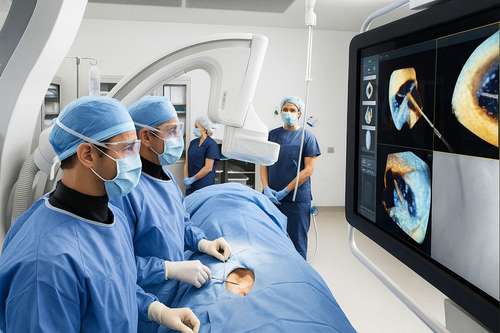
In a major signal that hospitals are ready to embrace full-scale automation, health tech innovator Apella has secured $80 million in Series B funding to expand its ambient AI platform across the United States. Announced this week, the investment underscores a critical shift in healthcare infrastructure: the move from manual, retrospective data entry to real-time, computer vision-driven insights that optimize operating room (OR) efficiency. Led by HighlandX, the round will fuel Apella’s mission to solve one of healthcare's most expensive bottlenecks—operating room underutilization.
Revolutionizing the Operating Room with Computer Vision
Operating rooms are the financial engine of most hospital systems, yet they remain plagued by inefficiencies, scheduling conflicts, and staffing shortages. Apella’s technology addresses these issues by installing privacy-compliant sensors and utilizing computer vision to act as an "always-on" air traffic controller for surgical suites. Unlike traditional systems that rely on nurses to manually log timestamps, Apella’s ambient AI healthcare platform autonomously tracks up to 14 distinct milestones during a surgery, from anesthesia induction to the final incision closure.
"Ambient AI is transforming healthcare," said David Schummers, co-founder and CEO of Apella. "We have applied this technology to the most critical part of the health system: the operating room. Our customers have expanded beyond the pilot phase, bringing Apella's product suite to enterprise-scale." This automated data collection allows surgical teams to focus entirely on patient care rather than administrative logging, seamlessly writing novel data back into the hospital’s Electronic Health Record (EHR) system.
Investment Powerhouses Back the AI Hospital Shift
The $80 million financing was led by HighlandX, with significant participation from a coalition of healthcare and tech investors. Returning backers include Vensana Capital, Casdin Capital, PFM Health Sciences, Upside Partnership, and Operator Partners. Notably, the round also attracted new strategic investors like K2 HealthVentures, OpAmp Capital, and Houston Methodist Hospital—a key customer that has already seen the technology's value firsthand.
This surge of capital in early 2026 highlights a broader trend in health tech investment: a move away from purely consumer-facing health apps toward deep infrastructure plays that improve hospital margins. As hospitals face continued staffing pressure, technologies that "find" hidden capacity without requiring physical expansion are becoming essential. Apella’s ability to unlock new surgical slots through better scheduling is a prime example of this value proposition.
Real-World Impact: Improving Access and Efficiency
The technology is already delivering measurable results. Houston Methodist, which participated in the funding round, has deployed Apella’s platform across more than 200 operating rooms. According to the hospital system, their initial pilot resulted in a 10% increase in monthly case volume, equating to an additional 33 surgeries per month in just a small subset of rooms. Across its broader customer base, Apella reports that hospitals see an average 5% increase in surgical volume simply by optimizing the schedule based on accurate, AI-derived case duration predictions.
Introducing Apella Horizon
Alongside the funding, the company is rolling out Apella Horizon, a new module specifically designed for surgical scheduling. By analyzing historical data and real-time signals, Horizon predicts case durations with high accuracy, allowing schedulers to fill gaps that would otherwise go unused. This operating room scheduling AI reduces the "white space" in OR calendars—time where a room sits empty and staffed—ensuring that more patients get the surgeries they need sooner.
The Future of AI Healthcare Infrastructure
As we move deeper into 2026, the integration of AI healthcare infrastructure is becoming a competitive differentiator for major health systems. The ability to passively collect data and turn it into actionable operational intelligence is no longer futuristic—it is a current operational imperative. Apella’s expansion plans involve not just scaling into more US hospitals but also deepening the technology’s capabilities in other procedural areas like interventional radiology and cardiology.
With this fresh capital, Apella is well-positioned to lead the "smart hospital" revolution, proving that the most effective AI isn't the one that replaces clinicians, but the one that makes their environment intelligent enough to support them seamlessly.