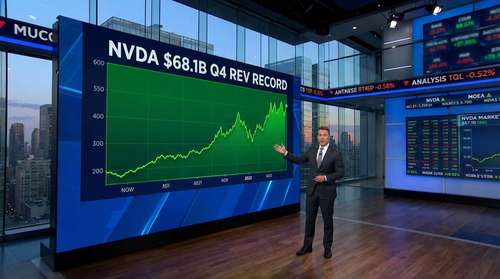
Nvidia (NASDAQ: NVDA) has once again defied gravity, delivering a blockbuster earnings report that has sent shockwaves through the global financial markets. On February 25, 2026, the semiconductor giant reported fourth-quarter fiscal 2026 revenue of $68.1 billion, a figure that not only shattered Wall Street estimates but also confirmed that the artificial intelligence market growth is far from hitting a ceiling. As markets opened on Thursday, the NVDA stock surge today led a broader tech rally, effectively silencing the growing chorus of critics who had warned of an impending AI bubble.
Fiscal Q4 2026 Earnings: By The Numbers
The numbers released by Nvidia are nothing short of historic. Analysts had pinned their hopes on a revenue target of approximately $66.2 billion, but the company delivered a staggering $68.1 billion, representing a 73% increase year-over-year. Adjusted earnings per share (EPS) came in at $1.62, comfortably beating the consensus estimate of $1.52. This marks yet another quarter of accelerating growth for the company, driven almost exclusively by insatiable demand for its data center products.
The Nvidia earnings Q4 2026 report highlights the company's unparalleled dominance in the semiconductor space. Data Center revenue alone surged by over 75%, fueled by massive capital expenditures from hyperscalers like Microsoft, Meta, and Google, who continue to build out the infrastructure necessary for next-generation AI models. "The demand visibility we have is unprecedented," said CFO Colette Kress during the call, noting that backlog for their newest chips extends well into late 2027.
Jensen Huang: "Blackwell Is Just the Beginning"
During the highly anticipated Jensen Huang earnings call, Nvidia's CEO struck a tone of supreme confidence. Addressing concerns about potential market saturation, Huang revealed that demand for the company's Blackwell architecture remains "off the charts," with supply sold out for the next 12 months. However, the real surprise was his commentary on the upcoming "Rubin" architecture, slated for broader rollout later this year.
"We are seeing the beginning of a new industrial revolution," Huang told investors. "Accelerated computing and generative AI have hit a tipping point. Blackwell is the workhorse of today, but our customers are already preparing their data centers for Rubin. The transition to sovereign AI infrastructure in nations across Europe and Asia is opening entirely new revenue streams that didn't exist two years ago." This forward-looking AI chip demand forecast provided the catalyst for the after-hours rally that pushed the stock price toward the $195 mark.
Silencing the AI Skeptics
Leading up to this report, a segment of the market had grown wary of the sustainability of AI spending. Bears argued that the return on investment (ROI) for generative AI applications was taking too long to materialize. Nvidia's results have effectively put those fears to rest for the time being. The report confirms that the biggest players in tech are not tapping the brakes; they are slamming on the accelerator.
The tech sector rally 2026 sparked by this news has lifted the entire semiconductor ecosystem. Shares of AMD, Broadcom, and TSMC all saw significant gains in early trading on Thursday. Analysts at Morgan Stanley noted in a morning brief that "Nvidia has proven that the AI CAPEX cycle is distinct from traditional software cycles—it is an infrastructure build-out comparable to the early internet era."
Guidance and Future Outlook
Perhaps the most bullish signal came from Nvidia's guidance for the first quarter of fiscal 2027. The company forecasts revenue of $78.0 billion, plus or minus 2%, a figure that implies sequential growth is actually re-accelerating. This projection blows past analyst expectations of $72.9 billion and suggests that the company's supply chain partners have successfully ramped up capacity to meet the overwhelming demand for advanced packaging and HBM (High Bandwidth Memory).
For investors, the message is clear: the AI supercycle is still in its early innings. While volatility is to be expected in high-growth semiconductor industry news, Nvidia's execution remains flawless. As the company prepares to ship its next generation of processors, the gap between Nvidia and its competitors appears to be widening, solidifying its position as the most important company in the modern economy.