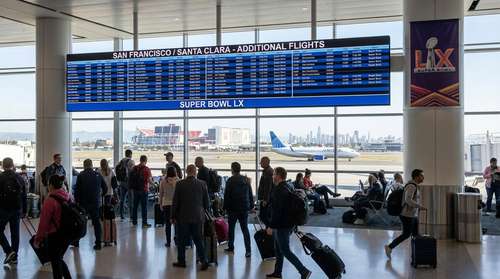
With exactly one week remaining until kickoff at Levi's Stadium, the travel scramble for Super Bowl LX has officially entered fever pitch. As fans from across the country finalize their pilgrimages to Santa Clara for the NFL's historic 60th anniversary championship, the Bay Area is witnessing an unprecedented strain on its logistics infrastructure. Hotel searches have spiked nearly 100% in the last 48 hours, prompting major carriers including Alaska Airlines and United to deploy dozens of emergency round-trip flights to San Jose (SJC) and San Francisco (SFO) to meet the surging demand.
Skies Crowded: Airlines Deploy Relief Flights
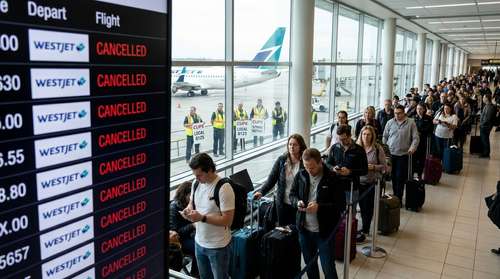
The rush to reach Northern California has forced airlines to rewrite their February schedules overnight. United Airlines, which operates a massive hub at SFO, confirmed early Sunday that it is adding over 40 direct flights from key NFL markets to the Bay Area between Thursday and Saturday. Alaska Airlines has followed suit, significantly boosting capacity into San Jose Mineta International Airport, the closest major airfield to the stadium.
"We are seeing demand levels that eclipse what we saw for Super Bowl 50 in 2016," said a source close to airport operations at SJC. The carrier adjustments aim to capture the wave of last-minute bookings from fans who waited until the conference championships settled to pull the trigger on travel. Ticket prices for these connector flights have understandably surged, with some economy seats commanding prices usually reserved for international business class.
Sticker Shock: Bay Area Hotel Prices Soar
If getting to the Bay is a challenge, staying there is a financial endurance test. Data from major booking platforms indicates that availability in Santa Clara and neighboring San Jose has effectively evaporated. The few remaining rooms within a 10-mile radius of Levi's Stadium are listing for astronomical rates, with standard accommodations commanding four-figure nightly prices.
The Santa Clara Accommodation Squeeze
Unlike other host cities with centralized downtown cores, the unique geography of the South Bay presents a specific challenge. Levi's Stadium sits in the heart of Silicon Valley, where business travel usually dominates. With the influx of over 75,000 expected attendees, the local inventory was overwhelmed months ago. The Bay Area Host Committee has reported that occupancy is pushing 98% across the Peninsula.
Travelers are now looking further afield, booking stays in Monterey, Santa Cruz, and even as far north as Napa Valley, planning to commute hours on game day. "We are advising fans to lock in whatever they can find immediately," noted a travel analyst covering the surge. "The window for 'deals' closed in December."
Ground Game: Navigating the Peninsula
The logistical puzzle extends to the ground. The distance between San Francisco's tourist hubs and the stadium in Santa Clara—roughly 40 miles—is a notorious traffic corridor. To mitigate the gridlock, the Santa Clara Valley Transportation Authority (VTA) has announced a massive expansion of service. Officials confirmed they are deploying 22 additional light rail trains to shuttle fans from Mountain View and Milpitas directly to the Great America station outside the stadium gates.
For fans staying in San Francisco, the focus is on Caltrain and charter buses. The Super Bowl Experience at the Moscone Center has become a central hub for shuttle information, with organizers desperate to keep cars off the 101 freeway. Rideshare surcharges are predicted to hit record multipliers on Sunday, making public transit the only predictable option for ticketholders.
The Fan Experience Factor
Despite the logistical headaches, the atmosphere on the ground is electric. The "Golden Anniversary" of the Super Bowl has brought an extra layer of pageantry to the region. With global superstar Bad Bunny set to headline the halftime show, a demographic of music fans is competing with football loyalists for space, further tightening the market.
As the countdown clock at the Super Bowl Village in San Francisco ticks down, the message to incoming travelers is clear: pack patience, download your transit apps now, and expect a very crowded, very expensive, but undeniably historic week in the Golden State.