
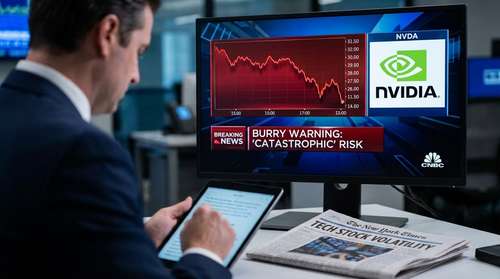
Nvidia shares slid over 4% in late trading this week, defying a blockbuster earnings report that saw the chipmaker shatter expectations with $68.13 billion in quarterly revenue. The counterintuitive market reaction comes on the heels of a stark warning from "The Big Short" investor Michael Burry, who highlighted a "catastrophic" risk in the company's exploding purchase obligations. While the AI giant reported a massive 65% year-over-year revenue surge for fiscal 2026, investors are spooked by parallels Burry drew between Nvidia’s current supply chain bets and the dot-com era collapse of Cisco Systems.
Record Earnings Meet Market Jitters
On paper, Nvidia’s fiscal 2026 performance was nothing short of historic. The company posted full-year revenue of $215.9 billion, up 65% from the previous year, with fourth-quarter revenue alone hitting $68.13 billion—a 73% jump compared to the same period last year. These figures comfortably beat Wall Street’s already lofty estimates.
However, the stock market’s response was chilly, with shares dropping roughly 5% in the aftermath. This "sell the news" reaction suggests that for many investors, perfection is now the baseline. With the stock price already baking in exponential growth, the focus shifted from what Nvidia earned to how it is achieving it, and specifically, the massive bets it is making on future demand.
Michael Burry’s $95 Billion Warning
The catalyst for much of the bearish sentiment was a pointed analysis from Michael Burry, the hedge fund manager famous for predicting the 2008 housing market crash. Burry zeroed in on a specific line item in Nvidia’s 10-K filing: purchase obligations.
According to Burry, Nvidia’s commitment to buy future inventory and capacity skyrocketed from $16.1 billion a year ago to a staggering $95.2 billion today. "This is not business as usual. This is risk," Burry noted. He argued that Nvidia is effectively locking itself into non-cancellable orders years in advance, betting the house that the insatiable demand for AI chips will continue indefinitely without a pause.
The Cisco Parallel
Burry’s critique didn't stop at the numbers; he drew a direct historical parallel to Cisco Systems during the dot-com bubble. In 2000 and 2001, Cisco similarly ramped up its purchase commitments to support a forecasted 50% annual growth rate. When the internet bubble burst and enterprise spending dried up, Cisco was left holding the bag, forced to write down billions in excess inventory.
By highlighting this similarity, Burry is suggesting that if AI demand softens even slightly, Nvidia could face a similar "catastrophic" inventory glut, turning its greatest strength—supply dominance—into a massive liability.
Wall Street Defends the AI King
Despite the doom and gloom from Burry, major Wall Street analysts rushed to Nvidia’s defense, interpreting the $95 billion obligation figure as a sign of strength rather than weakness.
Analysts at Bank of America raised their price target to $300, arguing that these massive commitments ensure Nvidia remains the "most dependable supplier" in the industry, effectively locking out competitors who can't secure similar capacity at TSMC. Similarly, JPMorgan analysts dismissed concerns about 2027 growth as "likely overblown," maintaining an Overweight rating and lifting their price target to $265.
Nvidia CFO Colette Kress also addressed the issue directly, stating that the company had "strategically secured inventory and capacity to meet beyond the next several quarters, further out in time than usual." From management's perspective, this isn't a gamble; it's a necessary moat to protect against supply shortages in a supply-constrained world.
Is the AI Bubble Leaking?
The divergence between Nvidia’s stellar financials and its falling stock price highlights a growing anxiety in the tech sector. Investors are beginning to question the sustainability of the massive capital expenditures (capex) from hyperscalers like Microsoft, Google, and Meta, who are Nvidia's biggest customers.
For now, the fundamentals remain rock-solid. But as Burry’s warning reminds us, in the semiconductor industry, the line between aggressive expansion and overextension is often only visible in the rearview mirror. Whether this drop is a buying opportunity or the first crack in the AI dam remains the multi-trillion-dollar question.