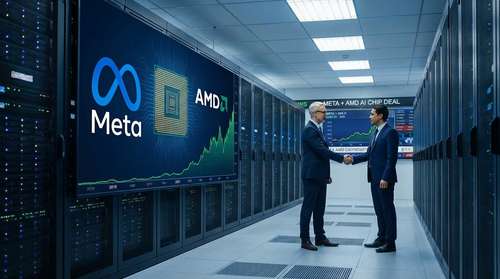
In a landmark move that has sent shockwaves through the semiconductor industry, Meta Platforms has finalized a multi-billion dollar agreement with AMD to supply next-generation AI processors. The deal, announced February 24, 2026, marks a pivotal shift in the AI semiconductor market competition, as Meta aggressively moves to diversify its infrastructure beyond Nvidia's hardware. Most notably, the agreement includes a highly unusual financial incentive: Meta has secured warrants to purchase up to 160 million AMD shares for a strike price of just one cent each, a provision that has ignited a massive AMD stock rally and contributed to a broader Nasdaq tech recovery today.
The Multi-Billion Dollar Deal: Breaking Down the Numbers
The partnership represents one of the largest single commitments to non-Nvidia AI hardware to date. Under the terms of the agreement, Meta will purchase up to 6 gigawatts of compute capacity powered by AMD's Instinct GPUs over the next several years. This massive deployment will feature AMD's custom MI450 accelerators and 6th-generation EPYC CPUs (codenamed "Venice"), all integrated into the new AMD Helios rack-scale architecture.
Industry analysts estimate the total value of the hardware procurement could exceed $60 billion over the life of the contract. "This is not just a supplier agreement; it is a strategic alignment of roadmaps," said AMD CEO Lisa Su during the announcement. Shipments for the first gigawatt of capacity are scheduled to begin in the second half of 2026, signaling that AMD is ready to deploy its flagship hardware at hyperscale speed.
The "One Cent" Warrant: A Financial Masterstroke
While the hardware volume is impressive, the financial structure of the deal is what has captured Wall Street's attention. To solidify the partnership, AMD granted Meta performance-based warrants to acquire 160 million shares of AMD common stock—roughly a 10% stake in the company—at a nominal exercise price of $0.01 per share.
This "Meta 1 cent AMD shares" provision is not a no-strings-attached gift. The warrants vest in tranches, contingent upon specific milestones:
- Shipment Targets: Vesting begins only after AMD successfully delivers the first 1 gigawatt of AI compute capacity.
- Performance Metrics: The hardware must meet strict technical uptime and efficiency benchmarks.
- Stock Price Targets: Full vesting requires AMD's stock price to hit ambitious targets, scaling up to $600 per share.
This structure aligns the interests of both tech giants perfectly. For Meta, it provides a massive potential financial upside that could offset infrastructure costs. For AMD, it locks in one of the world's largest AI spenders as a guaranteed long-term customer.
Meta's Strategic Pivot: Reducing Reliance on Nvidia
This deal is the clearest signal yet of Meta's AI infrastructure strategy shifting toward a multi-vendor approach. For years, Nvidia has held a near-monopoly on the high-end AI training market. By committing billions to AMD, Mark Zuckerberg is explicitly reducing Meta's dependence on a single supplier, a move designed to gain leverage in pricing and supply chain negotiations.
"We are building the compute foundation for personal superintelligence," Zuckerberg stated. "Diversifying our infrastructure is critical to ensuring we can scale without bottlenecks." While Meta continues to buy Nvidia H100 and Blackwell chips in massive quantities, the Nvidia vs AMD AI chips narrative has effectively changed from a monopoly to a competitive duopoly in the hyperscale data center.
Market Reaction: AMD Soars, Nasdaq Recovers
The market's response was immediate and electric. Following the announcement, AMD stock surged over 9% to close near $213.84, adding billions to its market capitalization. The rally helped fuel a broader Nasdaq tech recovery today, with the tech-heavy index climbing over 1% on February 25, 2026, as fears of an "AI bubble" temporarily subsided.
Broader Sector Impact
The news lifted the entire semiconductor sector. Investors interpreted the deal as validation that AI capital expenditure is not slowing down but accelerating. Even Nvidia shares held firm, rising slightly by ~2%, as the market realized that the total addressable market for AI hardware is growing fast enough to support multiple winners. However, the deal puts immense pressure on other challengers like Intel, who are struggling to capture meaningful market share in the AI accelerator space.
Outlook for 2026 and Beyond
As we move deeper into 2026, the AI semiconductor market competition is set to intensify. Meta's vote of confidence proves that AMD's software stack (ROCm) has finally matured enough to handle the most demanding production workloads. For investors and industry watchers, the focus now shifts to execution: Can AMD deliver on its 6-gigawatt promise on time? If they do, the "one cent" warrants could eventually make Meta one of AMD's largest shareholders, fundamentally intertwining the futures of these two Silicon Valley titans.