
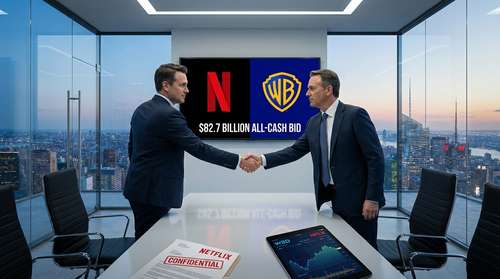
In a move that fundamentally rewrites the playbook for the global media industry, Netflix has submitted an amended, all-cash offer of $82.7 billion to acquire the studio and streaming assets of Warner Bros. Discovery (WBD). The historic bid, announced late Tuesday, January 20, 2026, is a direct strategic strike aimed at blocking a hostile takeover attempt by rival Paramount Skydance. This massive financial flex comes just hours after the streaming giant reported a blowout fourth quarter, shattering expectations by surpassing 325 million paid subscribers globally.
The Deal: All-Cash Dominance to Block Paramount
The revised proposal marks a significant shift from Netflix’s initial cash-and-stock offer. By putting $82.7 billion in liquid capital on the table—valued at $27.75 per share—Netflix is aiming to provide WBD shareholders with immediate, guaranteed value, removing the volatility risks associated with stock-based mergers. The Warner Bros. Discovery board has reportedly voted unanimously to recommend this transaction to its shareholders, signaling a clear preference for breaking up the company over selling it whole to Paramount Skydance.
Under the terms of this complex agreement, Netflix would acquire the "crown jewels" of the legacy media giant: the legendary Warner Bros. film and television studios, the HBO brand and library, the DC Universe, and the Max streaming service. Meanwhile, WBD’s linear television assets—including CNN, TNT Sports, and the Discovery Channel—would be spun off into a new, separate publicly traded entity tentatively named "Discovery Global."
Paramount Skydance's Hostile $108 Billion Bid
The all-cash pivot is a defensive maneuver against an aggressive $108.4 billion hostile takeover bid from Paramount Skydance. unlike Netflix's asset-specific acquisition, Paramount's offer is for the entirety of Warner Bros. Discovery. However, WBD leadership has argued that the regulatory hurdles and debt leverage required for the Paramount deal pose too great a risk. Netflix co-CEO Ted Sarandos, speaking on Tuesday's earnings call, emphasized that their deal offers "unrivaled certainty and a strategic accelerant" for the acquired studios, aiming for a shareholder vote as early as April 2026.
Financial Muscle: Q4 Earnings Reveal 325 Million Subscribers
Netflix's ability to finance such a colossal all-cash deal is underpinned by its sheer operational scale, which was on full display in its Q4 2025 earnings report. The company revealed it had added 23 million subscribers in 2025 alone, bringing its total global count to a staggering 325 million. Revenue for the quarter climbed 17.6% to $12.05 billion, driven by the successful crackdown on password sharing and the maturation of its advertising tier, which generated over $1.5 billion in 2025.
Despite these headline-beating numbers, Netflix stock (NFLX) slid approximately 5% in after-hours trading. Investors appear jittery about the short-term financial impact of the acquisition. To fund the $82.7 billion purchase, Netflix announced it would suspend its stock buyback program and take on significant bridge financing. "The destination is attractive, but the path is expensive," noted one media analyst, reflecting Wall Street's caution regarding the massive cash outlay required to integrate a legacy studio system.
Streaming Wars 2026: The Era of Mega-Consolidation
If approved, this acquisition would effectively end the "Streaming Wars" as we know them, crowning Netflix as the undisputed hegemon of digital entertainment. By absorbing HBO and Warner Bros., Netflix would gain ownership of some of the most valuable intellectual property in history, including Harry Potter, Game of Thrones, and Batman. This content arsenal would likely allow Netflix to raise prices further while reducing churn, a critical metric in the subscription economy.
The move also signals a broader trend of media industry consolidation in 2026. As tech-native streamers generate massive free cash flow, legacy media companies weighed down by declining linear TV revenues are becoming attractive targets for breakup. The creation of "Discovery Global" as a standalone entity for linear networks suggests that the market now views traditional cable assets as distinct—and perhaps less valuable—than the high-growth streaming and studio businesses.
What's Next for Shareholders?
For Warner Bros. Discovery investors, the choice is now stark but potentially lucrative. They stand to receive $27.75 per share in cash from Netflix, plus shares in the new Discovery Global company. This "have your cake and eat it too" structure is designed to be superior to Paramount's higher total offer, which carries significant regulatory risk and debt burdens. With the WBD board firmly on Netflix's side, all eyes now turn to the proxy statements expected in the coming weeks and the critical shareholder vote in April.